Where I live in eastern Ontario, Canada, an unusually cool, wet spring has generated sumptuous gardens, planting problems for farmers, hordes of hungry mosquitoes, and complaints from people bound for the beach.
But in the big picture, on the only planet we have, yesterday the US National Oceanic and Atmospheric Administration released its latest global climate report:
May 2014 was the warmest May on record.
Four of the five warmest Mays on record have occurred in the past five years.
May 2014 marked the 351st consecutive month with a global temperature above the 20th-century average.
When will we ever learn?
Scientists wrestle with urgent conundrums in Bold Scientists: dispatches from the battle for honest science, due September 20, 2014 from Between the Lines.
Henceforth, there will be no talk of climate change from any meteorologist employed by the Canadian Meteorological Service (a division of Environment Canada).
A government official who is permitted to talk to the media – but not to say anything of substance – told De Souza that meteorologists are qualified to talk about extreme weather, but not climate.
The ban – officially known as a “communications protocol” – extends the Harper regime’s aggressive silencing of scientists whose research might provoke questions about the regime’s pro-corporate, anti-environment agenda. True to the most insidious forms of censorship, the boundaries of what’s forbidden are not specified.
Apparently this ongoing reign of terror works. De Souza reports that, since the government’s 2007 decree that all federal scientists must obtain management approval before giving any interviews on their research, an internal Environment Canada analysis noted an 80 per cent drop in media coverage of climate change issues.
Fortunately, scientists are resisting. Follow their stories in Bold Scientists: dispatches from the battle for honest science, autumn 2014 from Between the Lines.
Unafraid to make his findings public, US climate scientist Michael E. Mann has become a favourite target of climate change deniers. For anyone interested in a livable future, he’s worth reading.
In the March 2014 issue of Scientific American he analyses the latest reports from the Intergovernmental Panel on Climate Change, and counters predictably comforting distortions in the mainstream US media.
Michael Mann concludes that the situation is not without hope, but argues that hope is rapidly fading. “Destructive change has already arrived in some regions. In the Arctic, loss of sea ice and thawing permafrost are wreaking havoc on indigenous peoples and ecosystems. In low-lying island nations, land and freshwater are disappearing because of rising sea levels and erosion.”
For an inside look at science and climate disruption, see Bold Scientists: dispatches from the battle for honest science, coming from Between the Lines, autumn 2014.
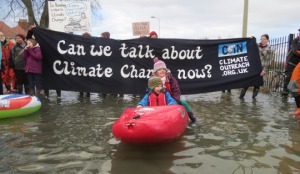
As Atlantic gales batter the south of England, and historic rains swamp other parts of it, a scan of mainstream British print media reveals that less than 1 in 10 of the stories about the floods venture to suggest any possible link to climate change.
(Photo: Climate Outreach)
At the same time, polls indicate that two thirds of people in the UK have never talked about climate change outside their immediate social circle, and a third of people have never talked about it with anyone at all.
I strongly suspect that the British are not unusual in their deathly silence on this most vital of all subjects. But:
This short February 13 commentary looks at one local attempt to break the silence, and make the link.
More on scientists and climate change/global warming in Pesky Facts: unspun science for dangerous times, coming from Between the Lines, autumn 2014.

 Peony at first light, my garden, June 2014

 Michael Riordon