Henceforth, there will be no talk of climate change from any meteorologist employed by the Canadian Meteorological Service (a division of Environment Canada).
A government official who is permitted to talk to the media – but not to say anything of substance – told De Souza that meteorologists are qualified to talk about extreme weather, but not climate.
The ban – officially known as a “communications protocol” – extends the Harper regime’s aggressive silencing of scientists whose research might provoke questions about the regime’s pro-corporate, anti-environment agenda. True to the most insidious forms of censorship, the boundaries of what’s forbidden are not specified.
Apparently this ongoing reign of terror works. De Souza reports that, since the government’s 2007 decree that all federal scientists must obtain management approval before giving any interviews on their research, an internal Environment Canada analysis noted an 80 per cent drop in media coverage of climate change issues.
Fortunately, scientists are resisting. Follow their stories in Bold Scientists: dispatches from the battle for honest science, autumn 2014 from Between the Lines.
Unafraid to make his findings public, US climate scientist Michael E. Mann has become a favourite target of climate change deniers. For anyone interested in a livable future, he’s worth reading.
In the March 2014 issue of Scientific American he analyses the latest reports from the Intergovernmental Panel on Climate Change, and counters predictably comforting distortions in the mainstream US media.
Michael Mann concludes that the situation is not without hope, but argues that hope is rapidly fading. “Destructive change has already arrived in some regions. In the Arctic, loss of sea ice and thawing permafrost are wreaking havoc on indigenous peoples and ecosystems. In low-lying island nations, land and freshwater are disappearing because of rising sea levels and erosion.”
For an inside look at science and climate disruption, see Bold Scientists: dispatches from the battle for honest science, coming from Between the Lines, autumn 2014.
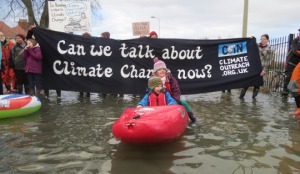
As Atlantic gales batter the south of England, and historic rains swamp other parts of it, a scan of mainstream British print media reveals that less than 1 in 10 of the stories about the floods venture to suggest any possible link to climate change.
(Photo: Climate Outreach)
At the same time, polls indicate that two thirds of people in the UK have never talked about climate change outside their immediate social circle, and a third of people have never talked about it with anyone at all.
I strongly suspect that the British are not unusual in their deathly silence on this most vital of all subjects. But:
This short February 13 commentary looks at one local attempt to break the silence, and make the link.
More on scientists and climate change/global warming in Pesky Facts: unspun science for dangerous times, coming from Between the Lines, autumn 2014.
In late summer 2013, we saw only three or four of these beautiful butterflies in our eastern Ontario garden, a stunning loss that many other people have confirmed. Here’s why. It’s a sad, infuriating story of nature, science and power abused. Deeply entwined with our own, the story of the Monarchs is bleak, but not finished.
From Andrea Germanos at the independent news site Common Dreams, on January 29, 2014:
A new report from the World Wildlife Fund and Mexico’s National Commission for Protected Areas found that the number of monarch butterflies hibernating in Mexico dropped to its lowest level since records began in 1993.
The insects make an epic journey of thousands of miles each year from Canada and the U.S. to spend November through March hibernating in Mexico’s temperate forests.
Clues that this year’s numbers would be the continuation of a troubling trend have been in for months, with the new study bringing more grim proof that the monarch is in trouble.
Using satellite and aerial photographs, the new study documented that 1.65 acres of forest were inhabited by monarchs during December of 2013, marking a 44% drop from the same time in 2012.
“Twenty years after the signing of NAFTA, the monarch butterfly migration – a symbol of cooperation between our three countries – is in grave danger,” stated Omar Vidal, WWF-Mexico Director General.
While the study focused on deforestation and forest degradation in monarch reserves that serve as their winter habitat, it points to a trio of perils contributing to declining numbers of monarchs.
There are 3 primary threats to the monarch butterfly in its range in North America: deforestation and degradation of forest by illegal logging of overwintering sites in Mexico; widespread reduction of breeding habitat in the United States due to land-use changes and the decrease of this butterfly’s main larval food plant (common milkweed [Asclepias syriaca]) associated with the use of glyphosate herbicide to kill weeds growing in genetically engineered, herbicide-resistant crops; and periodic extreme weather conditions throughout its range during the year, such as severe cold or cold summer or winter temperatures.
Other butterfly experts have pointed to these three factors as well, though Lincoln Brower, a professor of biology at Sweet Briar College who has studied the monarch migrations for decades, told the Washington Post‘s Brad Plumer that “The most catastrophic thing from the point of view of the monarch butterfly has been the expansion of crops that are planted on an unbelievably wide scale throughout the Midwest and have been genetically manipulated to be resistant to the powerful herbicide Roundup.”
Another leading scientist who has spent three decades studying the monarch, Karen Oberhauser, professor at the University of Minnesota, added to this point, saying “Numerous lines of evidence demonstrate that the Corn Belt in the U.S. Midwest is the primary source for monarchs hibernating in Mexico,” and the region has been hit by the explosive use of Roundup-resistant crops.
This has meant that milkweed, the host plant for the monarch caterpillar, is being wiped out from fields, something that Chip Ward, Director of Monarch Watch, has been documenting.
“These genetically modified crops have resulted in the extermination of milkweed from many agricultural habitats,” added Oberhauser.
Dr. Phil Schappert, a Canadian butterfly conservationist, added in a statement that “‘the economy first’ practices, instead of sustainable land use practices, threaten monarch habitat” in Canada, and urges his country and the United States to “implement measures that protect the reproductive habitat and feeding grounds of this butterfly. Otherwise, this spiral of population decline will continue,” Schappert added.
Monarch Watch’s Ward adds, “Let’s plant milkweed – lots and lots of it.”
More on GMOs vs conservation biology in Pesky Facts: unspun science for dangerous times, from Between the Lines, autumn 2014.
Canada’s Science Library Closures Mirror Bush’s Playbook. Details here. More detail in The Tyee’s follow-up story, here.
This is the next step in an escalating right-wing war on honest science and public knowledge, both of which the authorities fear and despise.
Their target, says Canadian paleolimnologist John Smol, is “pesky data” that challenges the government’s corporate agenda. They’ve already gutted a long hit list of vital research programs in Canada, including the world famous Experimental Lakes Area research facility.
John Smol: “The ELA has been a jewel in Canada’s crown – go to any water conference in the world, you just have to say ELA and everyone knows what you’re talking about. And it costs nothing to maintain. $2 million, what’s that, a penny per Canadian, so we don’t get toxic algae blooms, acid rain? It’s like claiming to save medical costs by not letting people have tests and checkups, the long-term data you need to maintain health. The ELA is exactly the kind of thing responsible government should be doing. So why are they closing the ELA? Because it provided pesky data, that’s why.”
(Follow this story in Pesky Data: unspun science for dangerous times. Coming in 2014 from Between the Lines.)
Scientists and other citizens who value public knowledge are resisting the destruction. At a public protest in Ottawa, thousands of scientists carried banners declaring: No Science, No Evidence; No Truth, No Democracy. The stakes are that high.
I have no illusions about the real impact of petitions. But at least the current leaders need to know that some of us are opposed. Here is an opportunity to say so.
Evidence for Democracy is a Canadian organization of scientists and citizens “who care passionately about the role that evidence needs to play in decision-making.” Recently they sent out this urgent appeal:
Irreplaceable scientific information is disappearing due to the recent closure of seven libraries run by Fisheries and Oceans Canada (DFO) and a number of Environment Canada and Natural Resources Canada libraries.
Scientists are saying that many of the books, reports and data at these libraries have already been discarded or destroyed without being properly digitized.
This priceless information is essential for the protection and security of Canada’s waterways. In particular, historical data and information provides the only baseline by which changes in the state of Canada’s aquatic ecosystems and fisheries resources can be evaluated. Without such trend data, assessing the impacts of policy and management decisions is impossible.
Please send a message to the federal party leaders and your member of parliament calling on them to stop closing our science libraries, and to ensure that the remaining information from the closed libraries is made available in a timely fashion.

 Photo: National Geographic


 Michael Riordon