How did they manage to turn Google into a verb? Here’s a clue:
A longish (10 – 15 minute read), eerily fascinating fragment from Julian Assange’s new book, When Google Met Wikileaks. In this excerpt Assange documents his bizarre encounter with Eric Schmidt, CEO of Google, one of the most powerful managers of information – our information – on the planet.
Eric Schmidt, Google CEO. Photo: Business Insider.
From the excerpt:
“I began to think of Schmidt as a brilliant but politically hapless Californian tech billionaire who had been exploited by the very U.S. foreign-policy types he had collected to act as translators between himself and official Washington.
“I was wrong.”
How wrong Julian Assange was, and how tightly enmeshed Google is in the US national security apparatus, he documents in meticulous, chilling detail. Here. Or here.
But all is not lost. There are alternatives to Googlism, created by people who value freedom – the real thing, not the flags-and-guns kind – over profit and power.
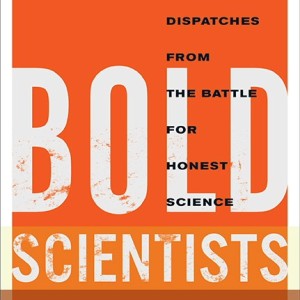
For deeper insight into the global shroud of state/corporate surveillance that’s tightening over us even as it seduces us into complicity, meet David Lyon, a world authority on surveillance and population control, in The Cloud, chapter 6 in Bold Scientists, here. (Scroll down to The Cloud.)
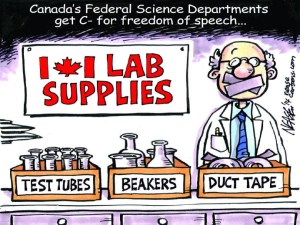
“A recent New York Times editorial, referencing the rapid development of the Alberta oil sands, went so far as to describe new communications restrictions on government scientists as ‘an attempt to guarantee public ignorance.’” – from an open letter to the current Canadian government, signed by more than 800 scientists from 32 countries.
Image: Steve Nease, The Toronto Star
The international roster of scientists called on the Harper government to end “burdensome restrictions on scientific communication and collaboration faced by Canadian government scientists.” More detail on the story here.
The call was made in an open letter drafted by the Cambridge, Mass.-based Union of Concerned Scientists. UCS represents U.S. scientists, and fosters “rigorous science to build a healthier planet and a safer world.”
The need for this unusual intervention is strongly reinforced in a new report from the Canadian organization Evidence for Democracy. It assesses the communication and media policies of 16 Canadian federal government departments.
For more on the fight for open science and democracy, see chapters 9 and 12 in Bold Scientists. Read an excerpt here.

 Author Michael Riordon in dialogue: Whole food for free range minds.

 Michael Riordon