Michael Riordon

the view from where I live


Leave a comment

Looking for a good hummus?

Good news from Earlham College in Richmond, Indiana (via Mondoweiss):

In Response to Student and Faculty Concerns, Earlham College’s Dining Services Stops Selling Sabra Products.

[MR:  Founded by Quakers in the mid-1800s, Earlham College is now a full-range arts and science university.  About 11% of its faculty and 12% of its students currently identify as Quakers.  From the university website: “Earlham emphasizes the pursuit of truth, lack of coercion, respect for others, openness to new truth, integrity and application of what is known to improving our world.”]

The full press release from BDS Earlham:

On September 5, Earlham College’s dining service agreed to have Sabra Hummus removed from the coffee shop after being informed of the involvement in Israeli human rights violations in Palestine by Strauss Group Ltd., of which Sabra Dipping Company, LLC is a subsidiary. The decision comes after a group of concerned students and faculty approached Earlham’s dining services requesting the removal of the product from the college’s facilities.

Strauss Group Ltd. provides financial support and supplies to the Golani and Givati brigades of the Israeli army, which is responsible for enforcing Israel’s illegal, 45-year-old military occupation and colonization of Palestinian lands, and other grave and systematic human rights abuses.

Basil Farraj of BDS Earlham commented, “We applaud Earlham College’s dining service for taking this principled stand and refusing to do business with Sabra Dipping Company.  Earlham students will no longer be unwittingly supporting Israeli abuses of Palestinian human rights when they purchase hummus and other products on campus.”

Earlham College’s dining services has promised to provide an alternative for the removed product, and noted that they take student concerns seriously and follow through with immediate action.

Two years ago Earlham students launched a campaign calling on the College to divest from Motorola Solutions, Caterpillar, and Hewlett Packard, three companies that profit from and enable Israeli violations of international law.  Last semester students with BDS Earlham also launched a “Dorm Storm” that has continued into the current school year, visiting all dorms and houses on campus, and engaging in discussions with students to educate them about the global Boycott, Divestment, and Sanctions (BDS) movement, launched by Palestinian civil society in 2005.

[MR:  Sabra Dipping Company is owned by two global food corporations – PepsiCo, based in the US, and Strauss Group, which is headquartered in Israel.  Sabra products are widely marketed throughout North America and Europe.  Fortunately, good alternatives are available in many places.  Or make your own, it’s much less expensive.  A simple, delicious recipe:

Prep Time: 10 minutes

Ingredients:

  • 1 16 oz can of chickpeas or garbanzo beans [or cook from dried, if you prefer]
  • 1/4 cup liquid from can of chickpeas
  • 3-5 tablespoons lemon juice (depending on taste)
  • 1 1/2 tablespoons tahini
  • 2 cloves garlic, crushed
  • 1/2 teaspoon salt
  • 2 tablespoons olive oil [preferably fair trade Palestinian]

Preparation:

Drain chickpeas and set aside liquid from can. Combine remaining ingredients in blender or food processor.  Add 1/4 cup of liquid from chickpeas.  Blend for 3-5 minutes on low until thoroughly mixed and smooth.

Place in serving bowl, and create a shallow well in the center of the hummus.  Add a small amount (1-2 tablespoons) of olive oil in the well.  Garnish with parsley (optional).

Serve with fresh, warm or toasted pita bread, or cover and refrigerate.

Variations:

For a spicier hummus, add a sliced red chile or a dash of cayenne pepper.

Storing Hummus:

Hummus can be refrigerated for up to 3 days and can be kept in the freezer for up to one month. Add a little olive oil if it appears to be too dry.

2 Comments

Zakaria Zubeidi on death fast

Urgent: From the Freedom Theatre, Jenin refugee camp, Occupied Palestine, September 9, 2012

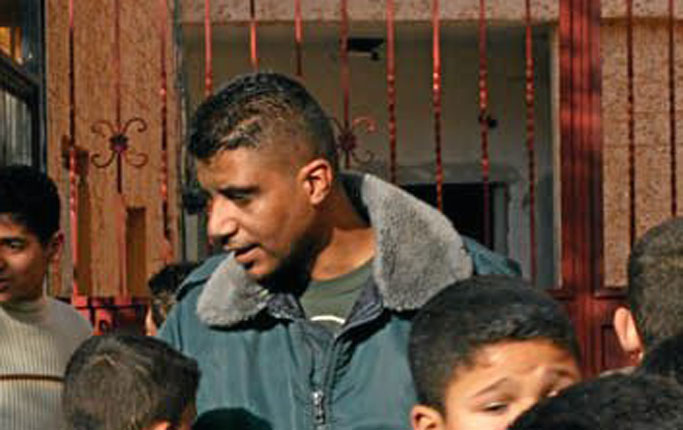
Zakaria Zubeidi, Jenin refugee camp

Zakaria Zubeidi’s release from prison has been postponed yet again, Palestinian Authority officials announced, for 8 more days of “additional investigations.”

Zakaria co-founded the Freedom Theatre with Juliano Mer Khamis.  [For more on the theatre, see Our Way to Fight, chapter 2.]  He has already been held four months by the Palestinian Authority without any charge or evidence of wrong-doing.   [MR: The Palestinian Authority makes no secret that its American-trained police collaborate closely with the Israeli occupation regime.]

In protest, Zakaria announced today that he will embark on a food and fluid strike, in effect a death fast.  Unless the Palestinian Authority can be pressured to release him, he will probably not survive through the week.

Throughout his imprisonment, which is illegal by international law, his rights has been severely violated, as detailed by Human Rights Watch, among others.

Some background (Human Rights Watch press release, July 27, 2012):  In May 2012 the Palestinian Authority (PA) arrested Freedom Theater co-founder Zakaria Zubeidi, held him incommunicado, and allegedly tortured him.  It arrested his defense lawyer in July.

Israeli authorities arrested the company’s artistic director, Nabil al-Ra’ee, in June, held him incommunicado, and allegedly subjected him to physical and psychological ill-treatment that may have amounted to torture, Human Rights Watch said.  Zubeidi’s lawyer and al-Ra’ee were recently released, but all three men still face charges.  [MR: Israeli military courts, the only ones permitted in the occupied West Bank, operate by their own laws.]

“Israel and the Palestinian Authority are trampling on the rights of the Freedom Theater’s staff,” said Joe Stork, deputy Middle East director at Human Rights Watch.  “A theater should be able to offer critical and provocative work without fearing that its staff will be arrested and abused.”

The theater’s director and co-founder, Juliano Mer-Khamis, an Israeli citizen and activist, was killed in April 2011.  Since the killing, Israeli occupation forces have repeatedly raided the theater and beaten and arbitrarily arrested employees.  Israeli authorities claim that they suspect theater staff of involvement in Mer-Khamis’s killing, but have not charged anyone with the crime, and have not provided any evidence to support their claim.  The Palestinian Authority appears to be abusing the theater’s staff because of the company’s criticisms of the PA’s rule.

Productions of the Freedom Theater have often criticized the Israeli occupation of the West Bank, as well as abuses by both Israel and the Palestinian Authority.  Like Zakaria Zubeidi, some staff and acting students are former members of Palestinian armed groups who renounced violence in favor of non-violent opposition to Israeli and PA policies.

Human Rights Watch declared that the arbitrary arrests and detentions should cease, and allegations of mistreatment should be investigated.

With Zakaria’s life at risk, the Freedom Theatre urges all its friends and supporters to:
– Contact the local representative office of the Palestinian Authority and demand Zakaria Zubeidi’s release.  Since the situation is urgent we also ask you to take more direct actions such as organizing protests at PA representative offices.
– Contact local or regional human rights offices and organizations such as Amnesty International and urge them to take action.
– Contact your local MP and MEP and urge them to take action.
– Contact your country’s representative office in the occupied Palestinian territory and urge them to take action.

[MR:  I understand that Israeli activists are starting a petition for Zakaria Zubeidi’s release.  As soon as it’s available, I’ll post the link.]


Leave a comment

“We should all have been standing there with her.”

More comment from Cindy and Craig Corrie, on the Israeli judge’s verdict that neither the state nor the army bears any responsibility for the murder of their daughter Rachel.  Thanks to Leehee Rothschild and the Mondoweiss blog for this:

While not holding their hopes high, the family is intent on pursuing the case and appealing to the Israeli Supreme Court. The Corries are seeking to draw attention to the story through the process and they feel obliged to continue promoting Rachel’s message of “building connections” through all possible means, among which the legal system is but one.  [MR: same reason I’m sharing the story here.  Please pass it on.]

Cindy and Craig Corrie.  (Photo: Canadian Broadcasting Corporation.)

“We started this trial seeking truth, but we also seek changes,” Cindy said.  Throughout the conference Rachel’s family continually stressed that their struggle for acknowledgment is inseparable from the Palestinian struggle.  They put Rachel’s presence in Rafah that day in the context of 16,000 who had lost their homes in the prior months, as well as the family of Rachel’s Palestinian friends, amongst them children, who were hiding behind the walls of the house that Rachel was protecting.  The Corries emphasized that many more Palestinians killed by the Israeli military cannot seek justice in the Israeli court systems, as they do, and that their struggle for justice is done in the name of Palestinians as well.

The family also highlighted, as did Israeli activists in a protest vigil outside the Tel Aviv court, that Israel’s impunity from international law must be ended.  Cindy Corrie stated, “My family and I personally, as well as the Rachel Corrie Foundation, are in full support of BDS [boycott, divestment, sanctions]”, as a means to this end.  She specifically voiced her support for the campaign targeting Caterpillar, manufacturers of the D9 bulldozer that killed Rachel, with whom the family has tried to communicate throughout the years, to no avail.

In the final question at the press conference, a reporter asked the Corries how they feel about the judge’s comment that Rachel should have moved out of the bulldozer’s way.

Cindy Corrie replied, “I don’t think that Rachel should have moved.  I think we should all have been standing there with her.”


Leave a comment

“Any thinking person”

In a Tel Aviv courthouse today, Judge Oded Gershon, a former military judge, ruled that the State of Israel bears no responsibility in the death of Rachel Corrie.

Rachel Corrie, Gaza, March 16, 2003

On March 16, 2003, Corrie, an American citizen, was crushed to death by an Israeli military Caterpillar D9-R bulldozer as she joined other activists in protesting the demolition of Palestinian homes in Rafah, Gaza.  She was 23.

After an Israeli army investigation predictably exonerated the soldiers involved, Rachel’s parents Cindy and Craig Corrie launched a wrongful death suit in 2005.  It charges the State of Israel with responsibility for Rachel’s killing and failure to conduct a credible investigation in the case. Apparently even the U.S. government, Israel’s most faithful backer, agrees. Last Friday The Guardian UK reported that Dan Shapiro, the US ambassador to Israel, told the Corrie family two weeks ago that the U.S. government “did not believe the Israeli military investigation had been ‘thorough, credible and transparent.'”

In his ruling, judge Oded Gershon said, “I reject the suit.  There is no justification to demand the state pay any damages.”  Calling Corrie’s death a “regrettable accident”, he said the state was not responsible because the incident had occurred during what he termed a war-time situation.

He added that the soldiers had done their utmost to keep people away from the site.  “She (Corrie) did not distance herself from the area, as any thinking person would have done.”

Though it was anticipated that the judge would whitewash the Israeli military, still his arrogant disregard for human rights and international law is a shock.

Cindy and Craig Corrie commented: “We are deeply saddened and troubled by what we heard today in the court of Judge Oded Gershon. This was a bad day, not only for us, but for human rights, for humanity, the rule of law, and the country of Israel.  From the beginning, it was clear that there was a system to protect the military and soldiers, to provide them impunity.  This extends to the courts.  The diplomatic process failed us. The Israeli court system demonstrated that it failed us too.  Rachel was a human being who deserved accountability, and we as her family deserve that too.”

The Corrie family’s attorney Hussein Abu Hussein commented, “We knew from the beginning that we had an uphill battle to get truthful answers and justice, but we are convinced that this verdict distorts the strong evidence presented in court, and contradicts fundamental principles of international law with regard to protection of human rights defenders.  In denying justice in Rachel Corrie’s killing, this verdict speaks to the systemic failure to hold the Israeli military accountable for continuing violations of basic human rights.”

In the United States, Jewish Voice for Peace also condemned the verdict.  “This verdict reflects the impunity of the Israeli army and the deficient investigation undertaken by Israel after Rachel’s death… JVP joins the Rachel Corrie Foundation in urging concerned activists in the US to mark the trial verdict with actions to end the housing demolitions that deny Palestinians the basic human right of being secure in their own homes.  We urge people to visit the local offices of retirement fund TIAA-CREF [a huge US pension fund management firm for people in academic, medical, cultural, governmental and research fields] to deliver a letter remembering Rachel Corrie and drawing attention to Israel’s policy of home demolitions, frequently carried out using Caterpillar bulldozers.

“While TIAA-CREF recently dropped Caterpillar from their social choice funds, they continue to invest over $1 billion in Caterpillar in their general funds.  Jewish Voice for Peace is the founding member of the national coordinating committee of the We Divest campaign demanding that TIAA-CREF divest from companies like Caterpillar that are profiting from the Israeli occupation.”

Omar Barghouti of the international BDS (Boycott, Divestment and Sanctions) movement added, “Given that Israel’s courts, like their South African counterparts during apartheid, have systematically and consistently been a reliable pillar of Israeli occupation, colonialism and apartheid, Israel’s war crimes and crimes against humanity ought to be prosecuted in international courts where justice has a chance to see the day of light.

“This should also convince anyone who still needed to be convinced that without effective BDS against Israel it will never comply with international law.  This was the lesson of South Africa.”


Leave a comment

More cracks in the wall

The forces arrayed against Palestinians are overwhelming.  Often they seem, as they are meant to seem, invincible.

History suggests that they are not.

For people in other countries who seek a just peace in Palestine-Israel, one of very few effective levers we have is BDS – boycott, divestment and sanctions.

Last week the United Church of Canada took a huge step forward in this vital arena.  The following op-ed by Peter Larson details how momentous it is.  Larson is Vice-President of the National Council on Canada-Arab Relations and chair of its Education committee on Israel/Palestine.  The op-ed was published August 21 in Embassy Magazine, an influential Canadian foreign policy publication.  Peter Larson:

The recent decision by an overwhelming majority of the nearly 400 delegates of the United Church of Canada to support a boycott of goods from the illegal Israeli settlements in the West Bank was significant in four important ways.  [MR: Boycott is one of several initiatives to be launched decided in the final resolution.  The document, not long, is well worth reading in detail.]

First, it’s remarkable that the Church has dared to approach this issue at all.  For too long, the Israel-Palestine issue has been stuck in what seems like a shouting match between those who support Israel unconditionally and those who are principally concerned about the fate of the Palestinians. Even trying to raise the subject in public often evokes reflexive cries of “anti-Semitism”.  But the United Church has shown that it is possible for Canadians to take a thoughtful, respectful, and fact-based approach to what is one of the thorniest and perhaps emotion-laden public policy issues for Canada and most other western countries.

Second, the decision was so overwhelming. Many had feared that the debate would split the 600,000 member church, causing irreparable damage to one of Canada’s most respected institutions.  Delegates were painfully aware that some groups were already painting the report as “unfair” and “unbalanced”.  They also knew that many of their own members were still very uncomfortable voicing public criticism of Israel.  Yet in the end, the vote was not even close.  A large majority supported the resolution.

Third, the Church’s deliberate and thoughtful process was respectful of all and every opinion. In fact, a similar motion was rejected by the Church’s General Council three years ago, in the face of strident opposition from various outside groups and concern among its members.  Faced with doubt, the delegates decided to set up a Working Group to give detailed study to the issue, which was instructed to report back to this General Council.

That working group travelled across Canada consulting church members and various outside partners including Muslim and Jewish organizations.  In addition, it made a two-week trip to the Israel and the Palestinian territories to see the situation on the ground first hand and meet with both Palestinians and Israelis.  (The working group was denied access to Gaza by the Israeli authorities, so the report’s coverage of Gaza is limited.)

After much research and investigation, the working group submitted its report and proposal for consideration to this year’s week-long General Council in Ottawa.

In essence, the report concluded that it was a moral duty for the Church to take a stand against Israel’s occupation of Palestinian land, and against the expansion of settlements as key obstacles to finding peace between Israelis and Palestinians.  These policies, it was pointed out on several occasions, are fully consistent with what is Canada’s official policy, though it is mostly ignored by senior government ministers.

The discussion on the report took place over several days, with many pauses for prayer and reflection.  Countless corrections and amendments were suggested – some were approved, some not.  United Church Moderator Mardi Tindal was unfailingly polite, respectful and thoughtful as she steered the discussion to a near unanimous conclusion.

The discussion on Israel/Palestine now moves back to hundreds of United Church congregations across Canada.  The report of the working group and the hours of intense discussion during the General Council have been a valuable educational process for the 400 or so UCC “commissioners”.  They return home with a much deeper understanding of the complicated Israel-Palestine issue and strengthened in their conviction that supporting the boycott of settlement products is neither unfair nor an act of anti-Semitism.

In short, the United Church of Canada has succeeded in bringing discussion about Israel/Palestine into the mainstream of Canadian moral and political conversation.

Consideration of what Canadians should do in the face of a 45-year old occupation, the illegal destruction of Palestinian homes, the suffering of over 4 million Palestinian refugees, or even what Canadians think about Israel as ‘a Jewish State’ in which Jews have many rights not shared by its non-Jewish citizens, has begun to expand from protest demonstrations to serious public discussion and policy change.

How long will it be before such an informed discussion reaches the ultimate public policy forum: Parliament itself?