“A recent New York Times editorial, referencing the rapid development of the Alberta oil sands, went so far as to describe new communications restrictions on government scientists as ‘an attempt to guarantee public ignorance.’” – from an open letter to the current Canadian government, signed by more than 800 scientists from 32 countries.
Image: Steve Nease, The Toronto Star
The international roster of scientists called on the Harper government to end “burdensome restrictions on scientific communication and collaboration faced by Canadian government scientists.” More detail on the story here.
The call was made in an open letter drafted by the Cambridge, Mass.-based Union of Concerned Scientists. UCS represents U.S. scientists, and fosters “rigorous science to build a healthier planet and a safer world.”
The need for this unusual intervention is strongly reinforced in a new report from the Canadian organization Evidence for Democracy. It assesses the communication and media policies of 16 Canadian federal government departments.
For more on the fight for open science and democracy, see chapters 9 and 12 in Bold Scientists. Read an excerpt here.
Tar sands oil is a cumulative disaster at every stage: extraction, processing, transport, refining, and end uses that dump incalculable amounts of greenhouse gases into the atmosphere.
But the oil industry and its government backers are hell bent on getting their dirty plunder to port, for shipment overseas to countries where they can get a higher price.
Lac-Mégantic oil train disaster, July 26, 2014. Photo: Boston Herald.
A well-oiled corporate/government PR machine relentlessly denies the overwhelming risks, even after they’re proven by bitter experience. Fortunately for all of us, people living along the routes are onto these lies, and organizing to block the dangerous traffic.
These two crucial initiatives need and deserve support:
* The Enbridge corporation is pushing to activate the notorious Line 9 through southern Ontario and Quebec. If they succeed, within the next few weeks this aging, vulnerable pipeline could be pumping heavy oil under pressure through a densely populated region laced with vital freshwater sources. Citizens groups along the way are working hard to stop it.
In June, 2014, the Chippewas of the Thames First Nation launched a legal challenge to the National Energy Board’s approval* of Line 9, on the grounds that constitutional obligations for consultation and accommodation of Aboriginal rights had not been met. (*The NEB pretends to be independent, but the federal government has effectively stacked it with oil/gas industry supporters.)
* Now the St. Lawrence River in eastern Canada is also being turned into a transport route for tar sands oil, one of the world’s dirtiest fuels. On September 24, the Suncor corporation shipped the first ever vessel of heavy crude down the St. Lawrence River from a port east of Montreal, bound for Italy. A second vessel was stopped recently on the St. Lawrence and temporarily blocked from departing for safety reasons.
The St. Lawrence River is the second longest river in Canada, flowing from the Great Lakes into the Gulf of St. Lawrence and the Atlantic Ocean. Along the way it provides drinking water to millions of people. The river includes four areas designated under the UN Convention of Wetlands of International Importance. The Gulf is the world’s largest estuary, bordering five of 10 Canadian provinces.
All of this faces imminent, irreversible threat. The oil corporations plan to send 20 to 30 vessels loaded with dirty crude down the river each year.
Good news: Margarita Zamora of Pro-Búsqueda nominated for a prestigious Tulip Human Rights Award. Voting has begun.
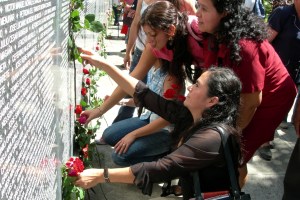
Margarita Zamora and other searching relatives,
at the Monument to Memory and Truth, San Salvador.
During the 1980s-90s military repression in El Salvador, Margarita Zamora lost her mother and six brothers, two of them killed. She still searches for her mother and four brothers, aged 9 months to 8 years when they disappeared during a ‘scorched earth’ military assault in the Chalatenango region. She also searches tirelessly, year after year, for thousands of other missing children.
Margarita coordinates the Research Unit of the Asociación Pro-Búsqueda in El Salvador. A citizens’ organization, Pro-Búsqueda (For the Search) strives to identify, locate and reunite with their birth families thousands of children forcibly disappeared during the war. Many of them were kidnapped by soldiers and given or sold into adoption, either with military families in El Salvador or in North America and Europe.
With Pro-Búsqueda since 2003, Margarita has conducted more than 1,000 interviews with family members and witnesses, and gathered more than 500 DNA samples for a genetic database that can match children and relatives. Her extraordinary skill in engaging people throughout El Salvador has been key to solving 60 cases to date.
But obstacles remain. Margarita explains, “The army holds important details – dates, names and places – which would help us solve many more cases as families are often too traumatized to remember. We have been asking the military for years to release their files. They always say yes, but these are just words.”
The work is also dangerous. At dawn on Thursday November 14, 2013, three armed men broke into Pro-Búsqueda’s office in central San Salvador, beat and handcuffed the security guard, an employee and a member of the board, poured gasoline over file cabinets in three offices, set them on fire, then stole several computers. Clearly the intent wasn’t vandalism but the destruction and theft of vital records and testimonies essential to human rights investigations. Pro-Búsqueda has changed its address, but not its mission to find the stolen children, to defend public memory that some would bury, and ultimately to bring perpetrators to justice.
The Human Rights Tulip is an award of the Netherlands Ministry of Foreign Affairs, for courageous human rights defenders who promote and support human rights in innovative ways. Each of the international nominees deserves acclaim. Based on my own inspiring encounters with Pro-Búsqueda people in writing Bold Scientists, I’ve cast my vote for Margarita Zamora. Please consider doing the same.
Stolen children: a gripping story of war, loss and reconciliation, science and human rights, in Bold Scientists. Read an excerpt here. (Scroll down to Chapter 5, Stolen children.)




 Michael Riordon