“Tremendously hopeful and profoundly disturbing.”
Great minds don’t think alike. They think differently. Here.


“Tremendously hopeful and profoundly disturbing.”
Great minds don’t think alike. They think differently. Here.
The bad news: Alberta pipeline spills 60,000 liters of crude oil into muskeg.
The spin: As usual, the industry and its government partners assure us that “clean-up efforts are underway.” What else can they say, spill after spill…
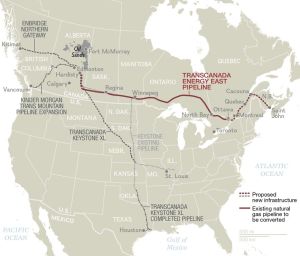
Tar sands pipelines. Image: newrepublic.com
The worse news: The industry is poised to send millions of gallons of this muck via pipelines and trains across thousands of kilometres/miles through every kind of terrain and aquifer to the west and east coasts, and south through the US.
The good news: Every step of the way, courageous people are resisting.
At Burnaby Mountain in British Columbia, more than 100 resisters have been arrested to date for trying to block a scheme by the Texas-based Kinder Morgan corporation to ram a pipeline through the mountain.
Canada’s National Energy Board granted the company rubber-stamp approval to proceed with test drilling, despite the fact that the pipeline will cross – invade, actually – territory which the Indigenous First Nations have never legally ceded to either the federal or provincial government.
In May, the Tsleil-Waututh Nation launched the first Indigenous legal challenge to oil sands pipelines crossing B.C., in a direct challenge to the National Energy Board’s deeply flawed ‘review’ process.
Last week, a provincial court judge threw out the charges against the Burnaby Mountain resisters, which included both First Nations and non-First Nations citizens.
Unfortunately, the judge’s ruling was based on Kinder Morgan having provided inaccurate GPS boundaries for its drilling sites, which leaves the company free to get a new revised injunction against the resisters.
Stakes for resisters also rose sharply when Kinder Morgan launched a $5.6 million lawsuit against several resisters and two university professors who have spoken out against the company’s pipeline test work on Burnaby Mountain.
Still, as the enormity of the threat become more and more apparent, resistance continues to grow across the continent. It takes many forms. This past week, Concordia University in Montreal became the first Canadian university to start divesting from fossil fuels.
For a scientist’s insight on the tar sands and climate change, see chapter 9, in Bold Scientists. Read an excerpt here. Scroll down to ‘Pesky data.’
The more people learn about the extreme dangers of bitumen, tar sands oil slurry, the more resistance grows along the planned routes of pipelines to transport the toxic muck across country to refineries and coastal ports. And as resistance grows, so do propaganda and dirty tricks from the industry and its partners in government.
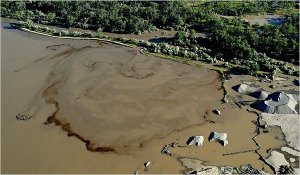
Oil pipeline spill, Yellowstone River, 2011. Photo: The New York Times.
A new must-read exposé from PRWatch, a US-based investigative research group, takes an inside look at what we can expect in the escalating battle over the proposed TransCanada pipeline from Alberta to Quebec/New Brunswick, aka “Energy East”:
“Leaked documents expose a plan for TransCanada to launch an ‘aggressive’ American-style PR campaign to persuade Canadians to support a Canada-based alternative to the stalled Keystone XL pipeline, to get controversial tar sands oil to refineries in eastern Canada for export. [MR: Prices are higher overseas, and diminished domestic supplies will ensure higher prices here, too. Oil-pushers call this a win-win situation.]
“According to the documents, this Canada-centric campaign would actually be run out of an office in Washington, DC. And the digital campaign is being led by a rightwing American political operative employed by the world’s largest public relations firm…”
Their battle plan includes investigations [read: attacks] on Canadian groups opposing the pipeline, and recruitment of buyable scientists “to build an echo chamber of aligned voices.”
Talk about 1984 (+ 30).
For an antidote, a dose of honest science, see chapters 9 & 10 in Bold Scientists. Read excerpts here.
“A recent New York Times editorial, referencing the rapid development of the Alberta oil sands, went so far as to describe new communications restrictions on government scientists as ‘an attempt to guarantee public ignorance.’” – from an open letter to the current Canadian government, signed by more than 800 scientists from 32 countries.
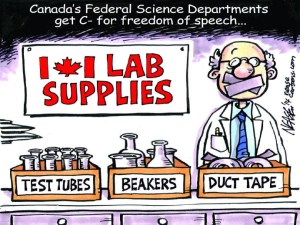
Image: Steve Nease, The Toronto Star
The international roster of scientists called on the Harper government to end “burdensome restrictions on scientific communication and collaboration faced by Canadian government scientists.” More detail on the story here.
The call was made in an open letter drafted by the Cambridge, Mass.-based Union of Concerned Scientists. UCS represents U.S. scientists, and fosters “rigorous science to build a healthier planet and a safer world.”
The need for this unusual intervention is strongly reinforced in a new report from the Canadian organization Evidence for Democracy. It assesses the communication and media policies of 16 Canadian federal government departments.
For more on the fight for open science and democracy, see chapters 9 and 12 in Bold Scientists. Read an excerpt here.
Tar sands oil is a cumulative disaster at every stage: extraction, processing, transport, refining, and end uses that dump incalculable amounts of greenhouse gases into the atmosphere.
But the oil industry and its government backers are hell bent on getting their dirty plunder to port, for shipment overseas to countries where they can get a higher price.

Lac-Mégantic oil train disaster, July 26, 2014. Photo: Boston Herald.
There is no safe transport method. Oil trains leak, derail and explode, oil pipelines leak and burst with shocking frequency.
A well-oiled corporate/government PR machine relentlessly denies the overwhelming risks, even after they’re proven by bitter experience. Fortunately for all of us, people living along the routes are onto these lies, and organizing to block the dangerous traffic.
These two crucial initiatives need and deserve support:
* The Enbridge corporation is pushing to activate the notorious Line 9 through southern Ontario and Quebec. If they succeed, within the next few weeks this aging, vulnerable pipeline could be pumping heavy oil under pressure through a densely populated region laced with vital freshwater sources. Citizens groups along the way are working hard to stop it.
In June, 2014, the Chippewas of the Thames First Nation launched a legal challenge to the National Energy Board’s approval* of Line 9, on the grounds that constitutional obligations for consultation and accommodation of Aboriginal rights had not been met. (*The NEB pretends to be independent, but the federal government has effectively stacked it with oil/gas industry supporters.)
The Chippewa challenge is yet to be heard in court, but a public petition in support of it is gathering momentum. Add your voice here: http://you.leadnow.ca/petitions/demand-the-neb-respect-indigenous-rights-sign-to-support-chippewas-of-the-thames-first-nation.
And:
* Now the St. Lawrence River in eastern Canada is also being turned into a transport route for tar sands oil, one of the world’s dirtiest fuels. On September 24, the Suncor corporation shipped the first ever vessel of heavy crude down the St. Lawrence River from a port east of Montreal, bound for Italy. A second vessel was stopped recently on the St. Lawrence and temporarily blocked from departing for safety reasons.
The St. Lawrence River is the second longest river in Canada, flowing from the Great Lakes into the Gulf of St. Lawrence and the Atlantic Ocean. Along the way it provides drinking water to millions of people. The river includes four areas designated under the UN Convention of Wetlands of International Importance. The Gulf is the world’s largest estuary, bordering five of 10 Canadian provinces.
All of this faces imminent, irreversible threat. The oil corporations plan to send 20 to 30 vessels loaded with dirty crude down the river each year.
The Council of Canadians is pressing federal elected representatives to stop tar sands oil shipments in the Great Lakes-St. Lawrence River Basin. Add your voice here: http://canadians.org/action/tar-sands-oil-shipments-st-lawrence-river-no-way.
Delve into the long struggle to defend the St Lawrence with Henry Lickers, Seneca First Nation biologist at Akwesasne, an island in the middle of the living river: When the river roared, chapter 1, Bold Scientists. Read an excerpt here: http://naturesciencepower.wordpress.com/inside-bold-scientists/excerpts/.
 Michael Riordon