Michael Riordon

the view from where I live


Leave a comment

Google: a slippery slope

“Who’s to say, now that Google has become an arm of law enforcement, how long that arm will reach?  I mean, can we really trust a giant transnational corporation to have our best interests at heart?”  Thom Hartmann, The Daily Take, via Truthout, August 06 2014.

Good questions.

Google spies

Bloomberg News, a US business paper, August 2013: “The government uses corporations to circumvent its prohibitions against eavesdropping domestically on its citizens. Corporations rely on the government to ensure that they have unfettered use of the data they collect.”

As Thom Hartman notes, “we can all agree that child porn is a bad thing.”  But then who’s next?  Recent exposures of NSA tactics by Edward Snowden and others have made clear that the surveillance state and its corporate partners will grab everything they can, then they decide later who and what is good or bad.

In Bold Scientists: dispatches from the battle for honest science, I asked David Lyon about the comforting mantra that if we’ve done nothing wrong, we have nothing to fear.  Director of the Surveillance Studies Centre, Queen’s University, Kingston, Canada, Lyon replied:  “The idea that I’m innocent until proven guilty is seriously compromised if I’m placed arbitrarily in a category of suspicion, and the reassuring notion that if I have nothing to hide I have nothing to fear is completely falsified when my name is put on a list about which I know nothing.”

Take this blog, for example.  Its purpose is to share news and questions about how science is done, and what impacts it has on nature and humanity.  But what’s to stop Google from deciding that a blog critical of Google should be shut down?

There are alternatives to the giant trawler called Google.  None of them is 100% secure, but at least some browsers are less inclined to sell us all to the highest bidder.  One example: DuckDuckGo.  And others.

So who cares, some say.

David Lyon again:  “Indifference is appropriate only for those who think that efficiency, convenience and speed qualify as values to be placed over openness, fairness, and the accountability of those whose task it is to process personal data.”

Join David Lyon in tracking the trackers.  Bold Scientists: dispatches from the battle for honest science, coming September 4, 2014 from Between the Lines.


Leave a comment

A multitude of threats

“The natural gas boom has led to cleaner power and greater energy independence. That’s why my administration will keep cutting red tape and speeding up new oil and gas permits.”

– President Barack Obama, February 12, 2013.

Not so fast.

fracking sign, no open flameFracking waste-water. Photo: SFAA News.

July 10, 2014, Concerned Health Professionals of New York released a report that sets the record straight on the hazards of fracking.  Sandra Steingraber, PhD, co-founder of  (CHPNY), explained to the press, “This compilation of findings brings together data from many fields of study, and reveals the diversity of the problems with fracking—from increased flood risks to increased crime risks, from earthquakes to methane leaks.  What this multitude of threats all have in common is the ability to harm public health.”   (From an EcoWatch report.)

In New York state, fracking – shattering the earth’s crust with a toxic mix of water and chemicals to extract gas and oil – has been held at bay so far by vigourous citizen opposition.  But as the industry spreads rapidly across North America and around the globe, it generates huge profits for corporations, and a tidal wave of misinformation from their enablers in government and the media.

Every place where fracking invades, public opposition springs up, but until recently it’s been hampered by lack of access to scientific data on the hazards. Now professional organizations like Concerned Health Professionals of New York (CHPNY) and Physicians, Scientists and Engineers for Healthy Energy (PSE) are breaking through industry/government secrecy to liberate the necessary data.

An invaluable resource, the ground-breaking (in the best sense) new report from CHPNY can be read and downloaded here.

Dig deep into the science vs fracking story in Bold Scientists: dispatches from the battle for honest science, coming September 2014 from Between the Lines.


Leave a comment

Weather report: no climate change.

extreme weatherPhoto: National Geographic

This week in Canada, the Harper regime decreed:

Henceforth, there will be no talk of climate change from any meteorologist employed by the Canadian Meteorological Service (a division of Environment Canada).

Investigative reporter Mike De Souza revealed the new ban here.

A government official who is permitted to talk to the media – but not to say anything of substance – told De Souza that meteorologists are qualified to talk about extreme weather, but not climate.

The ban – officially known as a “communications protocol” – extends the Harper regime’s aggressive silencing of scientists whose research might provoke questions about the regime’s pro-corporate, anti-environment agenda.  True to the most insidious forms of censorship, the boundaries of what’s forbidden are not specified.

Apparently this ongoing reign of terror works.  De Souza reports that, since the government’s 2007 decree that all federal scientists must obtain management approval before giving any interviews on their research, an internal Environment Canada analysis noted an 80 per cent drop in media coverage of climate change issues.

Fortunately, scientists are resisting.  Follow their stories in Bold Scientists: dispatches from the battle for honest science, autumn 2014 from Between the Lines.


Leave a comment

What are we waiting for?

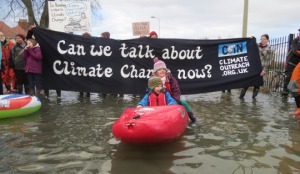
As Atlantic gales batter the south of England, and historic rains swamp other parts of it, a scan of mainstream British print media reveals that less than 1 in 10 of the stories about the floods venture to suggest any possible link to climate change.

Can we talk about climate change(Photo: Climate Outreach)

At the same time, polls indicate that two thirds of people in the UK have never talked about climate change outside their immediate social circle, and a third of people have never talked about it with anyone at all.

I strongly suspect that the British are not unusual in their deathly silence on this most vital of all subjects.  But:

This short February 13 commentary looks at one local attempt to break the silence, and make the link.

More on scientists and climate change/global warming in Pesky Facts: unspun science for dangerous times, coming from Between the Lines, autumn 2014.