Energy Minister Fergus Ewing announced that the moratorium would stand until “a full public consultation on unconventional oil and gas extraction” had been initiated and completed.
A week later, more good news: the Welsh government also voted to block fracking until it is proven safe for the environment and public health. Note: It cannot be proved safe, since it is everything but.
Neither of these initiatives is an outright ban, but in New York state, years of citizen campaigning led to a similar moratorium, and finally last month to a ban.
For a close look at the dirty business of fracking, see Bold Scientists. Scroll down to chapter 10, The unsolved problem.
In Independent Science News, January 12, Jonathan Latham sets out a stark bottom line for the survival of multi-cellular organisms – eg human beings – on this planet.
Latham: “The project to fully industrialise global food production is far from complete, yet already it is responsible for most deforestation, most marine pollution, most coral reef destruction, much of greenhouse gas emissions, most habitat loss, most of the degradation of streams and rivers, most food insecurity, most immigration, most water depletion, massive human health problems, and so on. Therefore, it is not an exaggeration to say that if the industrialisation of food is not reversed our planet will be made unlivable for multi-cellular organisms.”
So then, a matter of life and death. Jonathan Latham offers a recipe for survival. It’s worth a try.
For a taste of how to feed the world on a human scale, visit with Ann Clark, plant physiologist and farmer, in Bold Scientists, chapter 2, Digging thistles. Read an excerpt here.
The spin: As usual, the industry and its government partners assure us that “clean-up efforts are underway.” What else can they say, spill after spill…
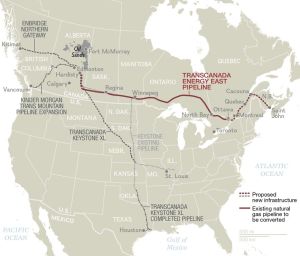
Tar sands pipelines. Image: newrepublic.com
The worse news: The industry is poised to send millions of gallons of this muck via pipelines and trains across thousands of kilometres/miles through every kind of terrain and aquifer to the west and east coasts, and south through the US.
The good news: Every step of the way, courageous people are resisting.
At Burnaby Mountain in British Columbia, more than 100 resisters have been arrested to date for trying to block a scheme by the Texas-based Kinder Morgan corporation to ram a pipeline through the mountain.
Canada’s National Energy Board granted the company rubber-stamp approval to proceed with test drilling, despite the fact that the pipeline will cross – invade, actually – territory which the Indigenous First Nations have never legally ceded to either the federal or provincial government.
Last week, a provincial court judge threw out the charges against the Burnaby Mountain resisters, which included both First Nations and non-First Nations citizens.
Unfortunately, the judge’s ruling was based on Kinder Morgan having provided inaccurate GPS boundaries for its drilling sites, which leaves the company free to get a new revised injunction against the resisters.




 Michael Riordon