Unafraid to make his findings public, US climate scientist Michael E. Mann has become a favourite target of climate change deniers. For anyone interested in a livable future, he’s worth reading.
In the March 2014 issue of Scientific American he analyses the latest reports from the Intergovernmental Panel on Climate Change, and counters predictably comforting distortions in the mainstream US media.
Michael Mann concludes that the situation is not without hope, but argues that hope is rapidly fading. “Destructive change has already arrived in some regions. In the Arctic, loss of sea ice and thawing permafrost are wreaking havoc on indigenous peoples and ecosystems. In low-lying island nations, land and freshwater are disappearing because of rising sea levels and erosion.”
For an inside look at science and climate disruption, see Bold Scientists: dispatches from the battle for honest science, coming from Between the Lines, autumn 2014.
As Atlantic gales batter the south of England, and historic rains swamp other parts of it, a scan of mainstream British print media reveals that less than 1 in 10 of the stories about the floods venture to suggest any possible link to climate change.
(Photo: Climate Outreach)
At the same time, polls indicate that two thirds of people in the UK have never talked about climate change outside their immediate social circle, and a third of people have never talked about it with anyone at all.
I strongly suspect that the British are not unusual in their deathly silence on this most vital of all subjects. But:
This short February 13 commentary looks at one local attempt to break the silence, and make the link.
More on scientists and climate change/global warming in Pesky Facts: unspun science for dangerous times, coming from Between the Lines, autumn 2014.
Through Access to Information searches, investigative journalist Matthew Millar reveals in the Vancouver Observer that the National Energy Board, a federal agency, coordinates a secret ongoing surveillance campaign against Alberta tar-sands opponents. The NEB collaborates with CSIS (Canadian Security Intelligence Service), the RCMP (Royal Canadian Mounted Police, which has its own national security apparatus), as well as private corporations implicated in the Alberta tar-sands and proposed pipelines.
This makes sense only as an (ideo)logical extension of the Harper regime’s faithful service to the oil and gas industry, combined with the paranoia of a repressive regime, as in:
3. Make metaphors.
O, what a tangled web we weave,
When first we practice to deceive!
– Sir Walter Scott, Marmion, 1808.
4. Make sense. “Given the presumed metabolic effort required by the spider for rebuilding an entire web, localized failure is preferential as it does not compromise the structural integrity of the web and hence allows it to continue to function for prey capture in spite of the damage.” Cranford, S.W. et al, Nature, 2012..
5. Make products. In the works: Tiny sutures for eye and nerve surgery, artificial ligaments and tendons, textiles for parachutes….
6. Make a superhero: 700 comic issues, 2 live-action TV series, 7 animated series, 4 movies (to date), video games, backpacks, blankets, water bottles, ball-caps, action figures, costumes, weapons, the most expensive Broadway musical in history…
7. Make military/police products. In the works: Comfy body armour for the imperial guard…
8. Awe. Or its close cousin, horror.
“All knowledge and wonder (which is the seed of knowledge) is an impression of pleasure in itself.” – Francis Bacon, The Advancement of Learning, 1605.
I would add: Wonder, or awe, is indispensable in the quest for knowledge. But it goes far too easily missing along the way. (Wonder and awe I count as degrees of the same response.)
Awe revels in the mystery, elegance and grandeur of existence. It is rooted in healthy humility. In awe, we know our place – in nature, not above it. Falling out of awe, we lose our place.
Wonder is spontaneous and ecstatic. Children feel it, uninhibited. Then we learn how to think, and then we learn what to think. Wonder is at risk. If it withers enough, eventually we have to pretend it. Or buy it.
Awe touches vast questions, some of them best left as questions. But religion and science keep trying to answer them.
On a mid-winter walk, breath clouds under clear sky, transparent to infinity. I watch rising sun brush grey tree-tops with a buttery glow. For an instant I feel its warmth, and the pleasure of it draws a smile. But in another instant, pleasure surrenders to memory – a hymn from Presbyterian childhood in another century:
When morning gilds the skies My heart awakening cries…
A rapturous image of awe. Then the author (unknown) delivers a message from the sponsor (unknowable):
…may Jesus Christ be praised.
Religion can’t resist transforming awe into worship, a more governable activity.
Science does something different, but remarkably similar. Very often it treats awe as superstition, a vestige, like the tailbone, of our primitive past. In doing so it lures wonder away from its natural object, the universe, to be dazzled instead by the brilliance of human science as it deconstructs the universe.
The lure is beguiling. When we reduce the universe to data it appears more manageable, less terrifying. Not an unreasonable goal in a universe that dispenses catastrophe as casually and indiscriminately as impressions of pleasure. But data is cold. It shrinks, chills, and eventually freezes wonder.
In 1605 Francis Bacon also wrote: “I am come in very truth leading to you Nature with all her children to bind her to your service and make her your slave.” – The Masculine Birth of Time.
A cruel paradox here: Nature enslaved can no longer elicit wonder. Yet Bacon calls wonder “the seed of knowledge.” Without seed, what can we expect to grow?
Awe induces respect. What we don’t respect we tend to neglect or destroy: people we dislike, countless fellow species, forests, oceans, air, the breath of life.

 Marshall Islands, going under. Photo: Agence-France Press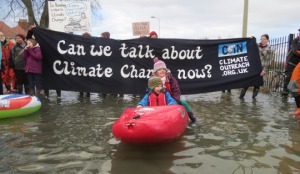


 Michael Riordon