Michael Riordon

the view from where I live


2 Comments

Good news: Scotland to ban growing of GM crops

Scottish Minister for the Environment, Food and Rural Affairs Richard Lochhead: “Banning growing genetically modified crops will protect and further enhance our clean, green status.”

Member of the Scottish Parliament Alison Johnstone: “GM is not the answer to food security, and would represent further capture of our food by big business.”

Scotland, landscape 2

Details of the ban are here.

Similarly, in 2014 Russia banned the import and cultivation of GM crops.  Prime Minister Dmitry Medvedev: “If Americans like to eat GMO products, let them. We don’t need to do that. We have enough space and opportunities to produce organic food.”

South of the border, the Conservative government of Britain has thrown open the door to GM crops.

In April, the European Commission reversed an earlier ban and approved the import of 10 new GM crops for human and animal consumption, including corn, soybeans, cotton and canola oil.

Meanwhile in the USA, the House of Representatives has just passed the perversely named “Safe and Accurate Food Labeling Act,” which prohibits state and local authorities from requiring safe and accurate GMO labeling. By now it’s clear that when consumers know about GMOs, they tend to be skeptical. But when they don’t know… It’s unlikely the Act will encounter any resistance in the Senate or the White House, both deeply beholden to the agri-chemical leviathans.

There is just one fly in the banning-GMOs ointment, but it’s a big one: Under massive international trade agreements like the Trans-Atlantic Trade and Investment Partnership (TTIP), negotiated in secret by corporate lobbies, corporations can sue any government bold enough to enact sensible, democratic measures meant to protect the public and the earth if there’s a chance they might limit actual or even potential corporate profits. A ban on GM crops is as likely a target as any.

Still, in taking responsible action, governments of countries like Scotland and Russia set an inspiring example of what is possible.

For a sane conversation on genetic manipulation and food security, visit Canadian scientist/farmer Ann Clark in Bold Scientists, here.  Scroll down to chapter 2, Digging for thistles.


1 Comment

Greece: It was a moment

Shining moments happen now and then. While the big ones demand attention, small ones often escape notice.  Some are in the eye of the beholder.

Lightning over parthenonThe Parthenon, Athens, Greece

For this beholder, a few of the big shining moments that come to mind: When years of massive popular uprising finally brought down the Marcos dictatorship in the Philippines. When Iceland defied the European bankers. When indigenous Bolivians forced US corporate giant Bechtel to drop its plan to make them pay for their own water, even for rain that fell from the Andean sky.  And then, just a week ago:

Despite a deluge of propaganda and threats, 61%of Greeks said Όχι, No! to financial-political strangulation by Euro-banks, Greek corporate gangsters and their wholly owned media.

That was a shining moment. It followed the January 2015 election of the Syriza movement to govern Greece, primarily on a promise to end imposed ‘austerity,’ a toxic mix of impoverishment and grand theft that had already devastated the country.

I am hungry for these shining moments, as I imagine many of us are. The big ones don’t come very often.  Our grasping at straws can make us naive, trip us up on our own illusions.

A week later, the Όχι moment is over.

Greek Prime Minister Alex Tsipras overrode democracy and the clear wishes of his own people to accept, behind closed doors, a set of conditions guaranteed to be even more viciously destructive to his country than the ones a strong majority of Greeks had just refused in their historic referendum.

In their castles today, the international bankers and politicians who serve them are surely celebrating. They have made an example of the Greek people, as kings used to do with heads on pikes: See what we do to those who defy us.

How Greeks who invested their hopes in the new government and its promises feel today, I can hardly imagine. The grief and rage of two other observers is eloquently expressed here, and here.

And in a rapidly growing international protest on Twitter, #ThisIsACoup, here.

But the story doesn’t end there. It continues where it always does, in Greece and everywhere else, often out of sight on streets, in markets, cafés and tavernas, in offices, schools and barracks.  People talk, they learn, they unravel the lies, patch the disappointments, share, organize, resist.  And so it goes.

The story also continues in the turmoil and the quiet of our minds, where many small shining moments are born.  Often they grow, and sometimes they bear fruit.


Leave a comment

The right to know

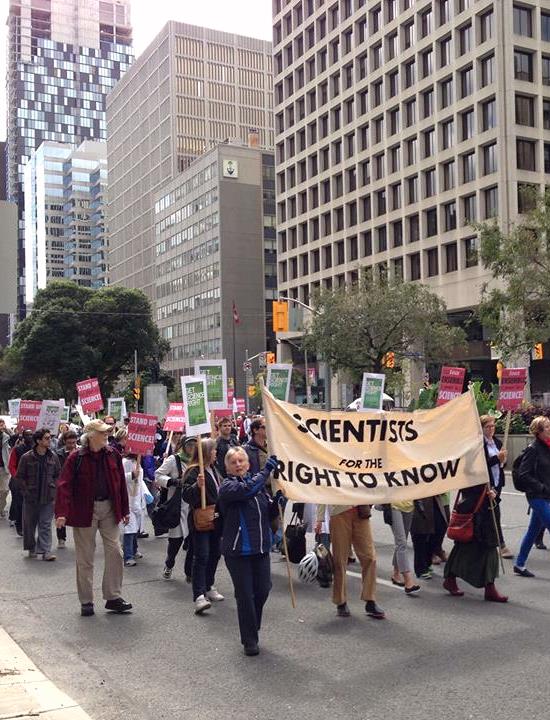
A new blog from Scientists for the Right to Know confronts an insidious threat to Canadian democracy.Scientists for the Right to Know, protest

The current regime in Ottawa acts on the premise that the less we citizens know, the easier we are to   manage. They don’t need objective evidence to make policy with impact on every aspect of life, only guile and brute force.

The resulting assault on the public right to know, here and internationally, takes many devious forms, detailed here.

Scientists for the Right to Know arises in direct response to this ominous assault.  “Please join us,” they invite, “in the fight to maintain Canada as a country in which policies are based on scientific knowledge, not uninformed ideology.”

The new SRK blog is here.  Full disclosure: Recently they published a piece by me, Questions need to be asked.  In any case, judging by the several posts they’ve put up so far, this looks to be a valuable voice – collection of voices – in defence of knowledge and democracy.

Others: Evidence for Democracy, and Write2Know.


Leave a comment

Bees and honest scientists: under attack

Honey bee, WesternHoney bee, Western.  Photo: commons.wikimedia.org

Bees keep us alive.  They and other insects pollinate two-thirds of all food crops.  No pollination, no food crops.

Bees and other pollinators are in great peril, their populations in sharp decline worldwide. A growing body of evidence identifies neonicotinoids, chemical pesticides that impair the neurological systems of insects, as a key factor in the decline.

Some of these chemicals are already banned or restricted in several European countries.  Yet neonicotinoids remain the most widely used pesticides on earth, generating enormous profits.

Scientists gather and interpret data to make the necessary links between neonicotinoids and bee collapse.  But in Canada and the USA scientists whose findings conflict with the corporate agenda are under escalating attack.  Currently in the US:

“Your words are changed, your papers are censored or edited, or you are not allowed to submit them at all.” – a senior scientist at the US Department of Agriculture Research Service.

“Censorship and harassment poison good science and good policy.” – Lori Ann Burd, environmental health director at the Center for Biological Diversity.

Details here.

Follow the Honey, a report from Friends of the Earth, exposes how agrochemical corporations obscure links between their chemicals and pollinator decline, and block government regulation.  Read it here.

For more on the battle for honest science, have a look inside Bold Scientists.


Leave a comment

Stolen children: Crime and immunity in El Salvador

In March 2015 a US immigration court ruled that Gen. Eugenio Vides Casanova, 77, can be deported from the United States to El Salvador, because “he participated in or concealed torture and murder by his troops” during the 1980 – 1992 war.  He is likely to appeal the ruling.
El_Salvador_disappeared
According to a UN commission of inquiry, over 75,000 people were killed during the war, more than 90% by the Salvadoran army and allied paramilitary forces, and 1000s of children disappeared. Some have been found in mass graves, but the vast majority simply vanished.

However, even if Vides Casanova returns to El Salvador, he could still avoid prosecution there. The country’s 1993 Amnesty Act guarantees immunity from prosecution to perpetrators of human rights crimes during the 12 years of military repression.  As long as this law remains in force, it denies any possibility of justice for victims and their families.

In the last fifteen years, similar laws shielding war criminals from prosecution have been overturned in Argentina, Uruguay, Peru, and Guatemala, and partially in Chile. But in El Salvador, a succession of governments have failed to repeal the amnesty law. The Inter-American Court of Human Rights has demanded several times that it be repealed, and Amnesty International continues to urge the same.

As it has always done, the Salvadoran military apparatus refuses to open its records, and no government has yet been willing to force it to do so. Lack of public access to these records not only shields perpetrators from justice, it also complicates greatly the work of Pro-Búsqueda (‘for the search’), a small Salvadoran grassroots organization run by the families of children who disappeared during the war.  Many of the children, it turns out, were kidnapped by soldiers and given or sold into adoption, primarily in North America and Europe.  Since 1993, Pro-Búsqueda’s mission has been to find them, and where possible to reunite them with their families of origin.  Continue reading