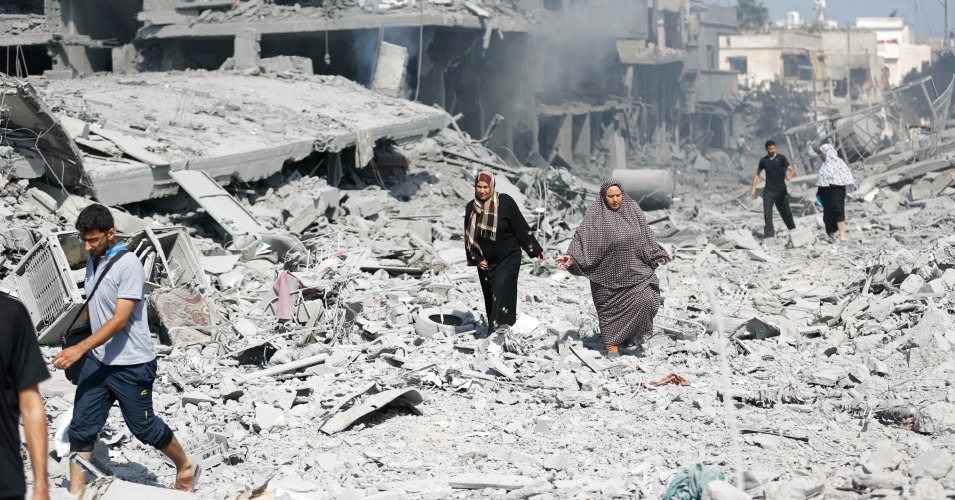
Gaza City, July 27, 2014. Photo: Oxfam International.
“For the last eight years, Israel and the U.S. had repeated opportunities to opt for a diplomatic solution in Gaza. Each time, they have chosen war, with devastating consequences for the families of Gaza.”
Why?
The answer is here, in a well-documented account by Sandy Tolan, author of The Lemon Tree: An Arab, a Jew, and the Heart of the Middle East, and an associate professor at the University of Southern California.
The only practical response that does not depend on goodwill or common sense from the Israeli or American authorities: the growing international grassroots movement for BDS – boycott, divestment and sanctions.
“A gripping tale of heroic scientists working in the public interest despite powerful
opposition. At once, both tremendously hopeful and profoundly disturbing. The world
needs more bold authors like Michael Riordon.”
Thomas Duck, Associate Professor, Department of Physics and Atmospheric Science,Dalhousie University, Halifax, Canada
“Silence is consent, my fellow scientists. Riordon’s profiles in courage encourage us to take our data and our voices into the gladiator’s arena and engage in the great moral and political battles of our time. As Bold Scientists so clearly shows, it’s where we belong.”
Sandra Steingraber, Ph.D., author of Living Downstream: An Ecologist’s Personal Investigation of Cancer and the Environment; co-founder, Concerned Health Professionals of New York
The menu/chapters:
When the river roared. First Nations, a long view.
Digging thistles. An experimental post-oil farm.
A dialogue with the world. Biology, from the ground up.
Blood on my hands. Life and death in the garden.
Stolen children.In El Salvador,war, genes and human rights.
The Cloud. Watching Big Brother.
ODD. Psychology and power
Awe. The wisdom of a spider web.
Pesky data. Under lakes, dark truths.
The unsolved problem. Fracking: homeland insecurity.
When the lights go out.Awakening in an ice storm.
No time for cowardice. An elemental fight for science and democracy.
Bold Scientists: dispatches from the battle for honest science
Now:
Pre-order it from independent bookstores and Chapters/Indigo stores across Canada.
After September 4th:
Purchase or order Bold Scientists from local retailers or libraries across Canada.
Purchase it directly from the publisher, Between the Lines, online (within Canada) at http://btlbooks.com/book/bold-scientists, or by phone toll-free at 1-800-718-7201.
As the Israeli attack on Gaza and the suffocating military occupation of the West Bank grind on, and resistance continues on both sides of the apartheid wall, Canadian publisher Between the Lines is featuring Witness, a chapter from Our Way to Fight: peace-work under siege in Israel-Palestine, on the front page of their website.
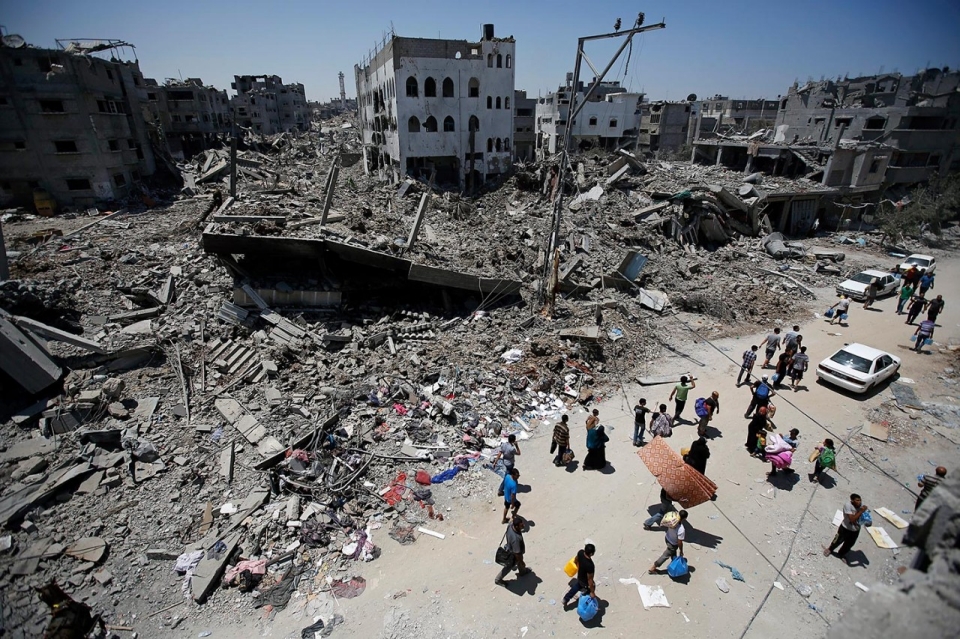
Shujaiyya, Gaza, August 1, 2014. Photo: Mohammed Saber.
Silence for Gaza, a poem by Palestinian poet Mahmoud Darwish, 1941 – 2008
Gaza is far from its relatives and close to its enemies, because whenever Gaza explodes, it becomes an island and it never stops exploding. It scratched the enemy’s face, broke his dreams and stopped his satisfaction with time.
Because in Gaza time is something different.
Because in Gaza time is not a neutral element.
It does not compel people to cool contemplation, but rather to explosion and a collision with reality.
Time there does not take children from childhood to old age, but rather makes them men in their first confrontation with the enemy.
Time in Gaza is not relaxation, but storming the burning noon. Because in Gaza values are different, different, different.
The only value for the occupied is the extent of his resistance to occupation. That is the only competition there. Gaza has been addicted to knowing this cruel, noble value. It did not learn it from books, hasty school seminars, loud propaganda megaphones, or songs. It learned it through experience alone and through work that is not done for advertisement and image.
Gaza has no throat. Its pores are the ones that speak in sweat, blood, and fires. Hence the enemy hates it to death and fears it to criminality, and tries to sink it into the sea, the desert, or blood. And hence its relatives and friends love it with a coyness that amounts to jealousy and fear at times, because Gaza is the brutal lesson and the shining example for enemies and friends alike.
Gaza is not the most beautiful city.
Its shore is not bluer than the shores of Arab cities.
Its oranges are not the most beautiful in the Mediterranean basin.
Gaza is not the richest city.
It is not the most elegant or the biggest, but it equals the history of an entire homeland, because it is more ugly, impoverished, miserable, and vicious in the eyes of enemies. Because it is the most capable, among us, of disturbing the enemy’s mood and his comfort. Because it is his nightmare. Because it is mined oranges, children without a childhood, old men without old age and women without desires. Because of all this it is the most beautiful, the purest and richest among us and the one most worthy of love.
We do injustice to Gaza when we look for its poems, so let us not disfigure Gaza’s beauty. What is most beautiful in it is that it is devoid of poetry at a time when we tried to triumph over the enemy with poems, so we believed ourselves and were overjoyed to see the enemy letting us sing. We let him triumph, then when we dried our lips of poems we saw that the enemy had finished building cities, forts and streets. We do injustice to Gaza when we turn it into a myth, because we will hate it when we discover that it is no more than a small poor city that resists.
We do injustice when we wonder: What made it into a myth? If we had dignity, we would break all our mirrors and cry or curse it if we refuse to revolt against ourselves. We do injustice to Gaza if we glorify it, because being enchanted by it will take us to the edge of waiting and Gaza doesn’t come to us. Gaza does not liberate us. Gaza has no horses, airplanes, magic wands, or offices in capital cities. Gaza liberates itself from our attributes and liberates our language from its Gazas at the same time. When we meet it – in a dream – perhaps it won’t recognize us, because Gaza was born out of fire, while we were born out of waiting and crying over abandoned homes.
It is true that Gaza has its special circumstances and its own revolutionary traditions. But its secret is not a mystery: Its resistance is popular and firmly joined together and knows what it wants (it wants to expel the enemy out of its clothes). The relationship of resistance to the people is that of skin to bones and not a teacher to students. Resistance in Gaza did not turn into a profession or an institution.
It did not accept anyone’s tutelage and did not leave its fate hinging on anyone’s signature or stamp.
It does not care that much if we know its name, picture, or eloquence. It did not believe that it was material for media. It did not prepare for cameras and did not put smiling paste on its face.
Neither does it want that, nor we.
Hence, Gaza is bad business for merchants and hence it is an incomparable moral treasure for Arabs.
What is beautiful about Gaza is that our voices do not reach it. Nothing distracts it; nothing takes its fist away from the enemy’s face. Not the forms of the Palestinian state we will establish whether on the eastern side of the moon, or the western side of Mars when it is explored. Gaza is devoted to rejection… hunger and rejection, thirst and rejection, displacement and rejection, torture and rejection, siege and rejection, death and rejection.
Enemies might triumph over Gaza (the storming sea might triumph over an island… they might chop down all its trees).
They might break its bones.
They might implant tanks on the insides of its children and women. They might throw it into the sea, sand, or blood.
But it will not repeat lies and say “Yes” to invaders.
It will continue to explode.
It is neither death, nor suicide. It is Gaza’s way of declaring that it deserves to live. It will continue to explode.
It is neither death, nor suicide. It is Gaza’s way of declaring that it deserves to live.
[Poem translated by Sinan Antoon From Hayrat al-`A’id (The Returnee’s Perplexity), Riyad al-Rayyis, 2007]
“Who’s to say, now that Google has become an arm of law enforcement, how long that arm will reach? I mean, can we really trust a giant transnational corporation to have our best interests at heart?” Thom Hartmann, The Daily Take, via Truthout, August 06 2014.
Good questions.
Bloomberg News, a US business paper, August 2013: “The government uses corporations to circumvent its prohibitions against eavesdropping domestically on its citizens. Corporations rely on the government to ensure that they have unfettered use of the data they collect.”
As Thom Hartman notes, “we can all agree that child porn is a bad thing.” But then who’s next? Recent exposures of NSA tactics by Edward Snowden and others have made clear that the surveillance state and its corporate partners will grab everything they can, then they decide later who and what is good or bad.
In Bold Scientists: dispatches from the battle for honest science, I asked David Lyon about the comforting mantra that if we’ve done nothing wrong, we have nothing to fear. Director of the Surveillance Studies Centre, Queen’s University, Kingston, Canada, Lyon replied: “The idea that I’m innocent until proven guilty is seriously compromised if I’m placed arbitrarily in a category of suspicion, and the reassuring notion that if I have nothing to hide I have nothing to fear is completely falsified when my name is put on a list about which I know nothing.”
Take this blog, for example. Its purpose is to share news and questions about how science is done, and what impacts it has on nature and humanity. But what’s to stop Google from deciding that a blog critical of Google should be shut down?
There are alternatives to the giant trawler called Google. None of them is 100% secure, but at least some browsers are less inclined to sell us all to the highest bidder. One example: DuckDuckGo. And others.
So who cares, some say.
David Lyon again: “Indifference is appropriate only for those who think that efficiency, convenience and speed qualify as values to be placed over openness, fairness, and the accountability of those whose task it is to process personal data.”
Join David Lyon in tracking the trackers.Bold Scientists: dispatches from the battle for honest science, coming September 4, 2014 from Between the Lines.

 Gaza City, July 27, 2014. Photo: Oxfam International.


 Michael Riordon