In the ever-deepening shadow of the national surveillance state, a bright gem of a story.
Alexandra Elbakyan’s ingenious online resource Sci-Hub has broken the corporate stranglehold on worldwide access to science research.
Science writer Simon Oxenham reveals why and how this brilliant young neurotechnology researcher in Kazakhstan did it. Details here, on Big Think.
It’s an inspiring account of knowledge gathered, privatized – imprisoned, really, to exploit for profit – and now, thanks to Alexandra Elbakyan, set free.
A fragment: “Only days after the [New York District] court injunction blocked Sci-Hub’s old domain, Sci-Hub was back online at a new domain accessible worldwide. Since then, the website has been upgraded from a barebones site that existed entirely in Russian to a polished English version proudly boasting a library of 48 million [research] papers, complete with a manifesto in opposition to copyright law. The bird is out of its cage.”
In part 2, here, Simon Oxenham pays tribute to pioneering internet creator and activist Aaron Swartz, who was ultimately hounded to death in 2013 by the US government.
Fortunately, at least for now, Alexandra Elbakyan and Sci-Hub remain beyond its imperial reach.
To encounter other scientists who defy the status quo, check out Bold Scientists: dispatches from the battle for honest science. Read excerpts here.
On a cool, bright autumn walk with Marla, I got to thinking about NIMBY. Not In My Backyard. It implies a perceived threat to the space that represents ‘my backyard.’ But what defines a backyard? Fences? Where I live we have none, except for ancient, collapsing cedar rails that now seem archeological.
We range freely through miles of forest, open meadow and wetland, far beyond the legal extent of the title deed that defines the 60 rural acres my partner and I ‘own.’ The land beyond is semi-wild, with no roads, no power lines, the occasional ATV incursion, and an abundance of animal tracks. I assume that someone ‘owns’ this other land; that’s how things have worked since the Europeans arrived. But for now, this is our extended backyard.
So then, what constitutes a backyard? If you’re an imperial power it means anything you want, up to and including the whole earth and as far out into space as you can grab. But what does it mean for the rest of us?
On my travels in writing Bold Scientists I visited with conservation biologist Curt Meine in the midwestern state of Wisconsin. Near Madison, the capital, we explored a devastated landscape, the former site of a vast military munitions complex, which citizens are working hard to restore to a healthy Sauk Prairie landscape. They hope to take care of it, as part of their extended backyard. But where are the boundaries?
As Curt sees it, “In nature the boundaries of larger reality are never set. In my little local place I can walk around, grow a garden, watch the birds, keep an eye on the sand cranes and the wild turkeys. I can only see about a mile, but I know the river out there is connected all the way to the Mississippi River, 80 miles that way (he points southwest, more or less), that feeds eventually into the Atlantic Ocean, which is part of the global ocean system. It’s the same with landscapes, they can be as small as a few square feet where you’re standing, and as large as the planet. Among all the levels are feedback loops, so they all affect each other.
“This means you can’t have a healthy farm or forest, park or city, in a landscape that’s unsustainable, or on a planet where the climate is going haywire, temperatures are rising, oceans are acidifying, and the poles are melting, largely due to our actions. So there’s always this tension between wanting to save the world at large and wanting to focus all your energies close to home. At least if you can work well on your part, and others are working well on their part, eventually you can build a community of engaged people to collaborate on the larger pieces of the whole.”
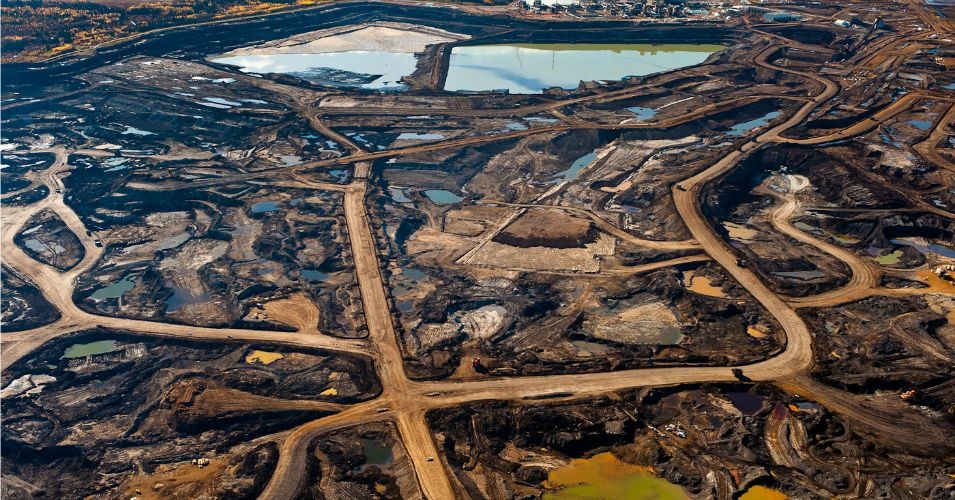
Imagine if in our backyard, our extended backyard, there were no tar sands. No oil and gas pipelines. No nuclear plants. No tops blown off mountains for coal. No fracking… Imagine.
Meantime, biologist Curt Meine carries on the long community struggle to restore one small sliver of this precious earth, ultimately the only backyard we’ve got. The story is here, in Bold Scientists.
Join me for a talk on gardening and the extended backyard, October 27, 2015, 6:30 – 8:30 pm, at the Toronto Reference Library.
The leap manifesto offers real grounds for real hope. Not the fast-food Hope marketed by cynical politicians, but the real thing, deeply transformative, built by all of us with open eyes, compassion, imagination, and yes, hard work.
Stephen Harper’s toxic legacy. (Photo: via PriceofOil.org)
The tar sands corporations and the Harper regime are hard to tell apart. Both believe that plunder is their right, even their duty. Both are obsessed with greed and power, their religion. Both do harm on an almost numbing scale, and call it “good management.” Both depend on each other in myriad ways for their survival. Both hate democracy.
In addition to the tar sands nightmare, the Harper regime has presided over a full spectrum of unnatural disasters, including: systematic assaults on environmental protections and honest science, starvation of the national health care system, massive surveillance, escalating military budgets and eager participation in criminal wars wherever US authorities choose to attack.
In a sane society, all of these would be considered major crimes. In Canada, the current regime hopes they will be grounds for their re-election.
I have no illusions about elections as a solution to the enormous problems we face. I know that once in power, none of the parties on offer will go nearly as far as I think they should to address these vital issues honestly, fairly, and adequately. But:
By now we know from bitter experience that if the Harper regime can fool enough Canadians into voting for it in October, the disasters will only deepen and multiply.


 Michael Riordon