The leap manifesto offers real grounds for real hope. Not the fast-food Hope marketed by cynical politicians, but the real thing, deeply transformative, built by all of us with open eyes, compassion, imagination, and yes, hard work.
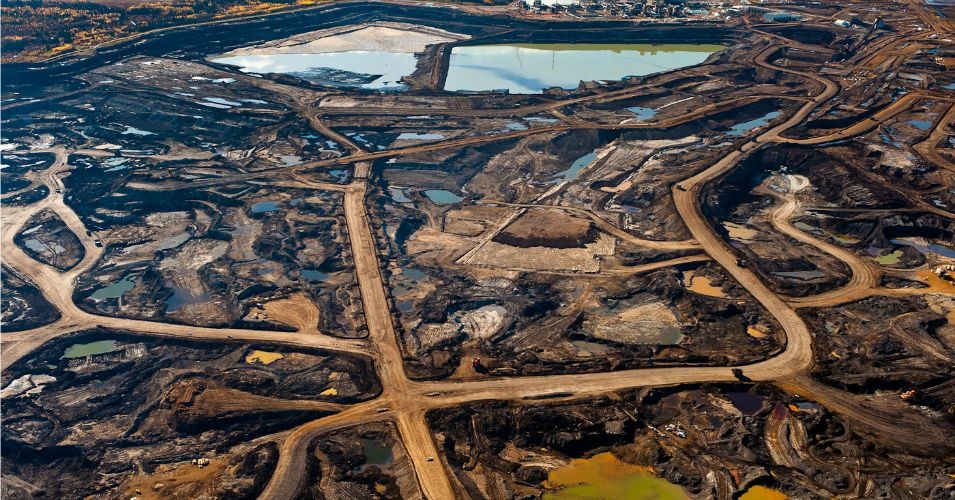
Stephen Harper’s toxic legacy. (Photo: via PriceofOil.org)
The tar sands corporations and the Harper regime are hard to tell apart. Both believe that plunder is their right, even their duty. Both are obsessed with greed and power, their religion. Both do harm on an almost numbing scale, and call it “good management.” Both depend on each other in myriad ways for their survival. Both hate democracy.
In addition to the tar sands nightmare, the Harper regime has presided over a full spectrum of unnatural disasters, including: systematic assaults on environmental protections and honest science, starvation of the national health care system, massive surveillance, escalating military budgets and eager participation in criminal wars wherever US authorities choose to attack.
In a sane society, all of these would be considered major crimes. In Canada, the current regime hopes they will be grounds for their re-election.
I have no illusions about elections as a solution to the enormous problems we face. I know that once in power, none of the parties on offer will go nearly as far as I think they should to address these vital issues honestly, fairly, and adequately. But:
By now we know from bitter experience that if the Harper regime can fool enough Canadians into voting for it in October, the disasters will only deepen and multiply.
Scottish Minister for the Environment, Food and Rural Affairs Richard Lochhead: “Banning growing genetically modified crops will protect and further enhance our clean, green status.”
Member of the Scottish Parliament Alison Johnstone: “GM is not the answer to food security, and would represent further capture of our food by big business.”
Similarly, in 2014 Russia banned the import and cultivation of GM crops. Prime Minister Dmitry Medvedev: “If Americans like to eat GMO products, let them. We don’t need to do that. We have enough space and opportunities to produce organic food.”
South of the border, the Conservative government of Britain has thrown open the door to GM crops.
In April, the European Commission reversed an earlier ban and approved the import of 10 new GM crops for human and animal consumption, including corn, soybeans, cotton and canola oil.
Meanwhile in the USA, the House of Representatives has just passed the perversely named “Safe and Accurate Food Labeling Act,” which prohibits state and local authorities from requiring safe and accurate GMO labeling. By now it’s clear that when consumers know about GMOs, they tend to be skeptical. But when they don’t know… It’s unlikely the Act will encounter any resistance in the Senate or the White House, both deeply beholden to the agri-chemical leviathans.
There is just one fly in the banning-GMOs ointment, but it’s a big one: Under massive international trade agreements like the Trans-Atlantic Trade and Investment Partnership (TTIP), negotiated in secret by corporate lobbies, corporations can sue any government bold enough to enact sensible, democratic measures meant to protect the public and the earth if there’s a chance they might limit actual or even potential corporate profits. A ban on GM crops is as likely a target as any.
Still, in taking responsible action, governments of countries like Scotland and Russia set an inspiring example of what is possible.
For a sane conversation on genetic manipulation and food security, visit Canadian scientist/farmer Ann Clark in Bold Scientists, here. Scroll down to chapter 2, Digging for thistles.
“I have seen what happens when standards of decency, human rights and ethics are thrown out in a wave of totalitarian or government zeal.” Steven Reisner, member of the Council, American Psychological Association, and co-founder of the Coalition for an Ethical Psychology.
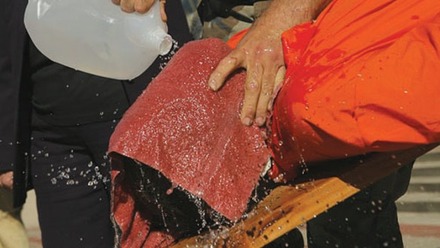
A shining moment: On Friday, August 7 in Toronto, Canada, the American Psychological Association voted to bar its 80,000 members from any further collaboration in ‘national security interrogations,’ ie torture by the American government and its agencies.
This historic shift was hard won, after a decade of grassroots organizing to counter APA executive deceit and collusion with the CIA.
Shining moments happen now and then. While the big ones demand attention, small ones often escape notice. Some are in the eye of the beholder.
The Parthenon, Athens, Greece
For this beholder, a few of the big shining moments that come to mind: When years of massive popular uprising finally brought down the Marcos dictatorship in the Philippines. When Iceland defied the European bankers. When indigenous Bolivians forced US corporate giant Bechtel to drop its plan to make them pay for their own water, even for rain that fell from the Andean sky. And then, just a week ago:
Despite a deluge of propaganda and threats, 61%of Greeks said Όχι, No! to financial-political strangulation by Euro-banks, Greek corporate gangsters and their wholly owned media.
That was a shining moment. It followed the January 2015 election of the Syriza movement to govern Greece, primarily on a promise to end imposed ‘austerity,’ a toxic mix of impoverishment and grand theft that had already devastated the country.
I am hungry for these shining moments, as I imagine many of us are. The big ones don’t come very often. Our grasping at straws can make us naive, trip us up on our own illusions.
A week later, the Όχι moment is over.
Greek Prime Minister Alex Tsipras overrode democracy and the clear wishes of his own people to accept, behind closed doors, a set of conditions guaranteed to be even more viciously destructive to his country than the ones a strong majority of Greeks had just refused in their historic referendum.
In their castles today, the international bankers and politicians who serve them are surely celebrating. They have made an example of the Greek people, as kings used to do with heads on pikes: See what we do to those who defy us.
How Greeks who invested their hopes in the new government and its promises feel today, I can hardly imagine. The grief and rage of two other observers is eloquently expressed here, and here.
And in a rapidly growing international protest on Twitter, #ThisIsACoup, here.
But the story doesn’t end there. It continues where it always does, in Greece and everywhere else, often out of sight on streets, in markets, cafés and tavernas, in offices, schools and barracks. People talk, they learn, they unravel the lies, patch the disappointments, share, organize, resist. And so it goes.
The story also continues in the turmoil and the quiet of our minds, where many small shining moments are born. Often they grow, and sometimes they bear fruit.




 Michael Riordon