Michael Riordon

the view from where I live


1 Comment

Όχι, No!

July 5, 2015, Greece: The referendum.

9.8 million eligible voters.
62.5% voted.

38.69% voted ναι, Yes.
61.31% voted όχι, No.

Greeks celebrate NoAthens, Sunday night, July 5. Photo: ibtimes.uk.

This is a first, a historic moment. An act of defiance and great courage. A sharp rupture with business as usual.

I’m sure that in voting No, people rejected many different but ultimately connected things: The threats and unbounded arrogance of international bankers and Euro-bosses, primarily the German Chancellor; the lies and corrosive contempt of the mainstream media; the corrupt, discredited old ruling parties of Greece; an indirect but obvious attempted coup against the government that Greek voters had just elected in January; a weary apathy born of repeated blows and letdowns; fear of the unknown, and more.

But most directly, a strong majority of Greek voters rejected a power structure they know very well by now through bitter lived experience, a system that makes a decent, sustainable life impossible for the many in order to indulge the insatiable greed of the few.

For people like me in other countries where No’s that challenge this power structure are routinely ignored, mocked or punished, this is a rare, thrilling moment, to be savoured.

To me, the Greek Όχι echoes another famous No!  During the Spanish civil war, people defending democracy from fascism boldly declared: No pasaran. They shall not pass. Sadly, the fascists did pass, and they are still with us. Even so, the original call has lost none of its abiding power: No pasaran!

No illusions here: The bankers and their faithful servants in government and media are still with us. They are mightily offended by the defiance of the Greeks. They fear that this ringing No! will inspire people suffering under the bankers’ heel in other places: Spain, Portugal, Italy, Ireland, Ukraine and beyond.

Syriza and the people of Greece face an enormously difficult path, a new path with no map. They will be bullied, bribed and beguiled to bow down or sell out.

With humble thanks, I wish them the clarity and courage to find their own way to a more reasonable, more compassionate, more authentically democratic future.


Leave a comment

The right to know

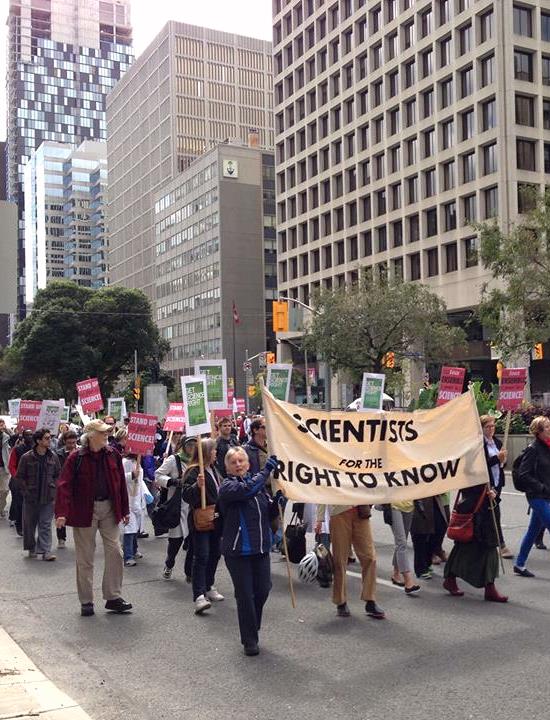
A new blog from Scientists for the Right to Know confronts an insidious threat to Canadian democracy.Scientists for the Right to Know, protest

The current regime in Ottawa acts on the premise that the less we citizens know, the easier we are to   manage. They don’t need objective evidence to make policy with impact on every aspect of life, only guile and brute force.

The resulting assault on the public right to know, here and internationally, takes many devious forms, detailed here.

Scientists for the Right to Know arises in direct response to this ominous assault.  “Please join us,” they invite, “in the fight to maintain Canada as a country in which policies are based on scientific knowledge, not uninformed ideology.”

The new SRK blog is here.  Full disclosure: Recently they published a piece by me, Questions need to be asked.  In any case, judging by the several posts they’ve put up so far, this looks to be a valuable voice – collection of voices – in defence of knowledge and democracy.

Others: Evidence for Democracy, and Write2Know.


Leave a comment

Bees and honest scientists: under attack

Honey bee, WesternHoney bee, Western.  Photo: commons.wikimedia.org

Bees keep us alive.  They and other insects pollinate two-thirds of all food crops.  No pollination, no food crops.

Bees and other pollinators are in great peril, their populations in sharp decline worldwide. A growing body of evidence identifies neonicotinoids, chemical pesticides that impair the neurological systems of insects, as a key factor in the decline.

Some of these chemicals are already banned or restricted in several European countries.  Yet neonicotinoids remain the most widely used pesticides on earth, generating enormous profits.

Scientists gather and interpret data to make the necessary links between neonicotinoids and bee collapse.  But in Canada and the USA scientists whose findings conflict with the corporate agenda are under escalating attack.  Currently in the US:

“Your words are changed, your papers are censored or edited, or you are not allowed to submit them at all.” – a senior scientist at the US Department of Agriculture Research Service.

“Censorship and harassment poison good science and good policy.” – Lori Ann Burd, environmental health director at the Center for Biological Diversity.

Details here.

Follow the Honey, a report from Friends of the Earth, exposes how agrochemical corporations obscure links between their chemicals and pollinator decline, and block government regulation.  Read it here.

For more on the battle for honest science, have a look inside Bold Scientists.


Leave a comment

Frack off!

With remarkable foresight, in March an NDP member of the Ontario legislature, Peter Tabuns, introduced a bill (proposed law) to ban fracking in Ontario.  (Fracking = hydraulic fracturing of the earth’s crust for gas and oil.)

With remarkable stupidity, the ruling Liberal government immediately denied any need for such a bill. There is no fracking yet in Ontario, said Natural Resources Minister Bill Mauro, so there is no need for a ban.  More detail here.

Fracking cartoonWithout a ban, the door stays wide open. Wherever the door is open, oil and gas corporations walk right in and start drilling. And wherever frackers drill, disaster follows.   Ask people on what’s left of the ground in Ohio, Pennsylvania, Texas, the Dakotas, south England…

Fracking consumes and poisons millions of litres of fresh water – for every well. The drillers inject a toxic brew of chemicals under high pressure to smash underground shale and force oil and gas to the surface. Fracking operations leak vast quantities of methane, a devastating greenhouse gas. They also set off earthquake epidemics where such incidents have been rare.  And then there are the pipelines to transport the gas/oil to refineries and ports, and with pipelines, spills and explosions.

Result: Immense profit for a few, incalculable harm for the rest of us and the earth.

Worldwide, as soon as people become informed about fracking, resistance grows rapidly, and people have won government bans and moratoria in many municipalities, provinces, states and countries. Check here for an up-to-date list.

Meanwhile in Ontario, the door – our door, by the way – remains wide open.

In a 2014 poll, 75% of Ontarians supported a moratorium on fracking.  As Peter Tabuns understands, the time to close the door is now, before it’s too late.

The bill to ban fracking is scheduled to come to a vote on May 7, a week from now.  Send a message to Premier Wynne, via a new email campaign from the Council of Canadians: Ban fracking in Ontario. Close the door now.

The underground story on fracking and the growing resistance is here, inside Bold Scientists.  Scroll down to chapter 10, The unsolved problem.