Michael Riordon

the view from where I live


Leave a comment

Frack off!

With remarkable foresight, in March an NDP member of the Ontario legislature, Peter Tabuns, introduced a bill (proposed law) to ban fracking in Ontario.  (Fracking = hydraulic fracturing of the earth’s crust for gas and oil.)

With remarkable stupidity, the ruling Liberal government immediately denied any need for such a bill. There is no fracking yet in Ontario, said Natural Resources Minister Bill Mauro, so there is no need for a ban.  More detail here.

Fracking cartoonWithout a ban, the door stays wide open. Wherever the door is open, oil and gas corporations walk right in and start drilling. And wherever frackers drill, disaster follows.   Ask people on what’s left of the ground in Ohio, Pennsylvania, Texas, the Dakotas, south England…

Fracking consumes and poisons millions of litres of fresh water – for every well. The drillers inject a toxic brew of chemicals under high pressure to smash underground shale and force oil and gas to the surface. Fracking operations leak vast quantities of methane, a devastating greenhouse gas. They also set off earthquake epidemics where such incidents have been rare.  And then there are the pipelines to transport the gas/oil to refineries and ports, and with pipelines, spills and explosions.

Result: Immense profit for a few, incalculable harm for the rest of us and the earth.

Worldwide, as soon as people become informed about fracking, resistance grows rapidly, and people have won government bans and moratoria in many municipalities, provinces, states and countries. Check here for an up-to-date list.

Meanwhile in Ontario, the door – our door, by the way – remains wide open.

In a 2014 poll, 75% of Ontarians supported a moratorium on fracking.  As Peter Tabuns understands, the time to close the door is now, before it’s too late.

The bill to ban fracking is scheduled to come to a vote on May 7, a week from now.  Send a message to Premier Wynne, via a new email campaign from the Council of Canadians: Ban fracking in Ontario. Close the door now.

The underground story on fracking and the growing resistance is here, inside Bold Scientists.  Scroll down to chapter 10, The unsolved problem.


Leave a comment

“We talk through the wall”

“Now comes my favorite time of day in jail—the two quiet hours between breakfast and 7 a.m. before the television clicks on and we are ordered to make our beds and the loud day begins…”

Sandra Steingraber letter from jail, Nov 2104

Photo: Common Dreams

Biologist and author Sandra Steingraber hand-wrote this letter from her cell in a New York county jail, writing on scrap paper provided by a fellow inmate, a young mother jailed for stealing a pumpkin.

Along with other resisters, Steingraber was jailed for non-violent civil disobedience. They tried to block the driveway of Texas-based Crestwood Midstream, which is pursuing a lunatic scheme to store under high pressure toxic products of fracking/hydraulic fracturing – methane, propane and butane – in abandoned, crumbling salt mines adjacent to Seneca Lake.

So far in the Seneca Lake campaign, 59 people have been arrested. The majority await sentence.

They consider the cost of doing time very small compared to the cost of doing nothing.  Steingraber writes, “…Time offers the possibility of rededicating oneself to the necessary work ahead: dismantling the fossil fuel industry in the last 20 years left to us, before the climate crisis spins into unfixable, unending calamity.”

Read Sandra Steingraber’s eloquent account here, on EcoWatch via Reader Supported News.

More on the ominous links between fracking and climate chaos, and the powerful interests driving both, here.  (Scroll down to chapter 10, The Unsolved problem.)


Leave a comment

Snake oil: a must-read exposé

The more people learn about the extreme dangers of bitumen, tar sands oil slurry, the more resistance grows along the planned routes of pipelines to transport the toxic muck across country to refineries and coastal ports.  And as resistance grows, so do propaganda and dirty tricks from the industry and its partners in government.

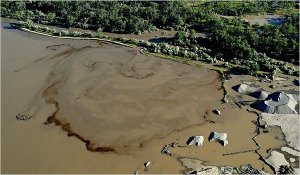
Pipeline spill, Yellowstone River

Oil pipeline spill, Yellowstone River, 2011. Photo: The New York Times.

A new must-read exposé from PRWatch, a US-based investigative research group, takes an inside look at what we can expect in the escalating battle over the proposed TransCanada pipeline from Alberta to Quebec/New Brunswick, aka “Energy East”:

Leaked documents expose a plan for TransCanada to launch an ‘aggressive’ American-style PR campaign to persuade Canadians to support a Canada-based alternative to the stalled Keystone XL pipeline, to get controversial tar sands oil to refineries in eastern Canada for export. [MR: Prices are higher overseas, and diminished domestic supplies will ensure higher prices here, too. Oil-pushers call this a win-win situation.]

“According to the documents, this Canada-centric campaign would actually be run out of an office in Washington, DC. And the digital campaign is being led by a rightwing American political operative employed by the world’s largest public relations firm…”

Their battle plan includes investigations [read: attacks] on Canadian groups opposing the pipeline, and recruitment of buyable scientists “to build an echo chamber of aligned voices.”

Talk about 1984 (+ 30).

The dirty details are here.

For an antidote, a dose of honest science, see chapters 9 & 10 in Bold ScientistsRead excerpts here.


Leave a comment

Not in my backyard

DSCF4867

Marla, in our extended backyard.

On a cool, bright autumn walk with Marla the dog, I got to thinking about NIMBY.  Not In My Backyard.  It implies a perceived threat to a space that represents ‘my backyard.’  But what defines a backyard? Fences? Where I live we have none.

We range freely through miles of forest, open meadow and wetland, far beyond the extent of the title deed that defines the 60 rural acres my partner and I own. This other land is semi-wild, with no roads, no power lines, the occasional ATV track, and an abundance of animal tracks. I assume that someone owns this other land; that’s how things have gone since the Europeans invaded. But for now, this is our extended backyard.

So then, what constitutes a backyard? If you’re an imperial power it means anything you want, up to and including the whole earth and as far out into space as you can grab. But what does it mean for the rest of us?

On my travels for the book I visited with conservation biologist Curt Meine in the midwestern state of Wisconsin. Near Madison, the capital, we explored a devastated landscape, the former site of a vast military munitions complex, which citizens are working hard to restore to a healthy Sauk Prairie landscape. They hope to take care of it, as part of their extended backyard. But where are the boundaries?

As Curt sees it, “In nature the boundaries of larger reality are never set. In my little local place I can walk around, grow a garden, watch the birds, keep an eye on the sand cranes and the wild turkeys. I can only see about a mile, but I know the river out there is connected all the way to the Mississippi River, 80 miles that way (he points southwest, more or less), that feeds eventually into the Atlantic Ocean, which is part of the global ocean system. It’s the same with landscapes, they can be as small as a few square feet where you’re standing, and as large as the planet. Among all the levels are feedback loops, so they all affect each other.

“This means you can’t have a healthy farm or forest, park or city, in a landscape that’s unsustainable, or on a planet where the climate is going haywire, temperatures are rising, oceans are acidifying, and the poles are melting, largely due to our actions. So there’s always this tension between wanting to save the world at large and wanting to focus all your energies close to home. At least if you can work well on your part, and others are working well on their part, eventually you can build a community of engaged people to collaborate on the larger pieces of the whole.”

Imagine if in our backyard, our extended backyard, there were no tar sands. No oil and gas pipelines. No nuclear plants. No tops blown off mountains for coal. No fracking.  But we need energy, we need gas, we need…. Yes, yes, but just for a moment, imagine.

Meantime, join biologist Curt Meine in the long community struggle to restore one small sliver of this precious earth, the only backyard we’ve got.  In Bold Scientists.


Leave a comment

Canadian government spies on tar sands opponents

Shocking, but not surprising:

tar sandsPhoto: vtdigger.org

Through Access to Information searches, investigative journalist Matthew Millar reveals in the Vancouver Observer that the National Energy Board, a federal agency, coordinates a secret ongoing surveillance campaign against Alberta tar-sands opponents.  The NEB collaborates with CSIS (Canadian Security Intelligence Service), the RCMP (Royal Canadian Mounted Police, which has its own national security apparatus), as well as private corporations implicated in the Alberta tar-sands and proposed  pipelines.

This makes sense only as an (ideo)logical extension of the Harper regime’s faithful service to the oil and gas industry, combined with the paranoia of a repressive regime, as in:

Anger erupts over Harper’s ‘enemy’ listThe National Post, July 17, 2013.

Government labels environmentalists “terrorist threat” in new report.  The Vancouver Observer, Feb 10, 2012.

Stay tuned…

What’s Next? when science, nature and power collide.  Coming in 2014 from Between the Lines, Canada.