The current regime in Ottawa acts on the premise that the less we citizens know, the easier we are to manage. They don’t need objective evidence to make policy with impact on every aspect of life, only guile and brute force.
The resulting assault on the public right to know, here and internationally, takes many devious forms, detailed here.
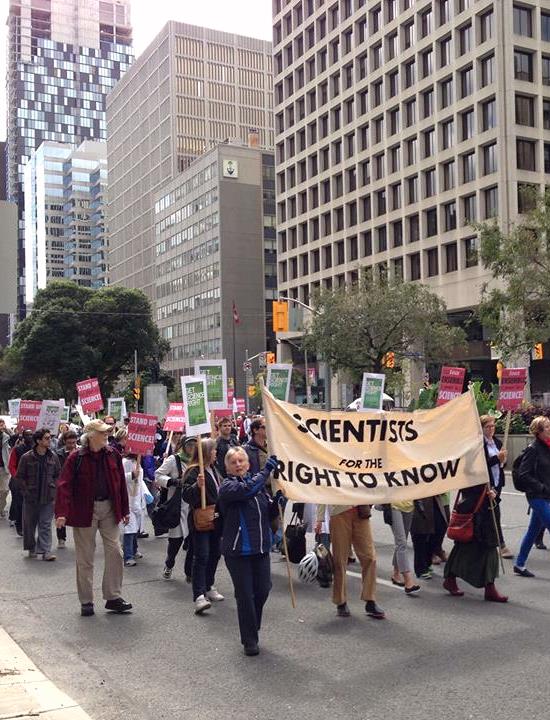
Scientists for the Right to Know arises in direct response to this ominous assault. “Please join us,” they invite, “in the fight to maintain Canada as a country in which policies are based on scientific knowledge, not uninformed ideology.”
The new SRK blog is here. Full disclosure: Recently they published a piece by me, Questions need to be asked. In any case, judging by the several posts they’ve put up so far, this looks to be a valuable voice – collection of voices – in defence of knowledge and democracy.
Bees keep us alive. They and other insects pollinate two-thirds of all food crops. No pollination, no food crops.
Bees and other pollinators are in great peril, their populations in sharp decline worldwide. A growing body of evidence identifies neonicotinoids, chemical pesticides that impair the neurological systems of insects, as a key factor in the decline.
Some of these chemicals are already banned or restricted in several European countries. Yet neonicotinoids remain the most widely used pesticides on earth, generating enormous profits.
Scientists gather and interpret data to make the necessary links between neonicotinoids and bee collapse. But in Canada and the USA scientists whose findings conflict with the corporate agenda are under escalating attack. Currently in the US:
“Your words are changed, your papers are censored or edited, or you are not allowed to submit them at all.” – a senior scientist at the US Department of Agriculture Research Service.
“Censorship and harassment poison good science and good policy.” – Lori Ann Burd, environmental health director at the Center for Biological Diversity.
Follow the Honey, a report from Friends of the Earth, exposes how agrochemical corporations obscure links between their chemicals and pollinator decline, and block government regulation. Read it here.
In March 2015 a US immigration court ruled that Gen. Eugenio Vides Casanova, 77, can be deported from the United States to El Salvador, because “he participated in or concealed torture and murder by his troops” during the 1980 – 1992 war. He is likely to appeal the ruling.
According to a UN commission of inquiry, over 75,000 people were killed during the war, more than 90% by the Salvadoran army and allied paramilitary forces, and 1000s of children disappeared. Some have been found in mass graves, but the vast majority simply vanished.
However, even if Vides Casanova returns to El Salvador, he could still avoid prosecution there. The country’s 1993 Amnesty Act guarantees immunity from prosecution to perpetrators of human rights crimes during the 12 years of military repression. As long as this law remains in force, it denies any possibility of justice for victims and their families.
In the last fifteen years, similar laws shielding war criminals from prosecution have been overturned in Argentina, Uruguay, Peru, and Guatemala, and partially in Chile. But in El Salvador, a succession of governments have failed to repeal the amnesty law. The Inter-American Court of Human Rights has demanded several times that it be repealed, and Amnesty International continues to urge the same.
As it has always done, the Salvadoran military apparatus refuses to open its records, and no government has yet been willing to force it to do so. Lack of public access to these records not only shields perpetrators from justice, it also complicates greatly the work of Pro-Búsqueda (‘for the search’), a small Salvadoran grassroots organization run by the families of children who disappeared during the war. Many of the children, it turns out, were kidnapped by soldiers and given or sold into adoption, primarily in North America and Europe. Since 1993, Pro-Búsqueda’s mission has been to find them, and where possible to reunite them with their families of origin. Continue reading →
Best comment, from Gary Magwood: “Daryl’s office called the police because we were ‘disruptive’, we were ‘noisy,’ and – here’s the best part – we were distracting the office staff from attending to constituents’ concerns. Now don’t you love that for double-speak? Aren’t we constituents?”
Which is exactly why so many Canadians regard Bill C-51 and its authoritarian authors as a threat to national security.
After participating in the Belleville protest, I reported having mixed feelings, even doubts, about its value.
After protests across the country and from many sources, the ruling Conservative regime has made a show of amending the bill. Like paint slapped on a rotting house, the proposed changes will have minimal impact on the bill’s nightmarish potential.
So, today’s protest.
Where: At the Belleville constituency office of Daryl Kramp, the local Member of Parliament. He’s a Conservative, ie a Northern Republican, and he’s chairing the committee currently sliding the bill through Parliament. Kramp was absent from the Belleville office today, being rather busy in Ottawa.
Who: 40 – 50 people from the area who are alarmed enough by what they’ve learned about this bill to protest it in public. The rally was called on short notice, in response to the proposed ‘amendments.’
After a few decades protesting a panorama of injustices, bigotry, stupidity, greed, crimes against the earth, abuse of power, state terror and such, at today’s protest I experienced a familiar mix of reactions:
I believe it’s crucial to be here, to inform the powerful that some of us see through their lies, and care enough to resist their schemes to the extent that we can. On the other hand, knowing how power is constructed, I suspect our resistance is too little, too late. On the other hand, it’s crucial that we be here. On the other hand…
This mix, and the gradual shedding of illusions over years, eventually led me to stop going to protests like this one. But then I was grateful that some people took the trouble to organize it, and that other people bothered to show up on a bright spring afternoon in the middle of a week. But then I know well enough that the real decisions are made far from here, in cabinet rooms and board rooms, by sociopaths in suits, over lunch.
Even so, how can I justify staying home in my comfortable, safe little cave, pretending that I accomplish anything that matters simply by writing? And who knows what effect each of these acts of resistance might have? The arrogant managers would have us believe they are oblivious to our protests, and nothing we do will make any difference. But when they lie about practically everything else, why not about this, too? Wouldn’t things be that much worse if we left them to their own devices?



 Michael Riordon